


Challenge
How can we design and rigorously evaluate a work model that combines in-person and teleworking to improve productivity, the quality of public service and people's well-being, while promoting work-life balance and attracting talent?
Problematic
In 2015, the AOC Consortium began implementing teleworking one day a week for some of its staff, after evaluating the characteristics and requirements of each job. To make this possible, the organization prepared itself to guarantee remote work in optimal conditions, adapting the service e-SET which is offered for small municipalities to the organization itself: adapting the information systems to allow telematic access, applying the corresponding cybersecurity measures to protect the organization against intrusions and attacks, and digitizing all procedures, both internal and external, to ensure their management regardless of the workplace of the person in charge of the task to be performed. This adaptation was namedAddress.
This prior effort was key when, in 2020, the COVID-19 pandemic forced all administrations to deploy teleworking suddenly and widely. The AOC, as a technologically mature organization that bases its work on an intensive use of digital tools, was able to adapt quickly to the new context, guaranteeing the continuity of the service and the ordinary functioning of the organization and responding adequately to a growing demand for digital services.
Over time and once the emergency situation was overcome, theopportunity to rethink the work model and move towards a more flexible approach adapted to the new times. As a result of this reflective process, the AOC defined its own hybrid and flexible work model, which combines the benefits of face-to-face work with those of remote work. However, implementing this model involves a complex organizational challenge which affects the way teams are organized, people are coordinated, and leadership is exercised.
To ensure that this model is truly efficient, sustainable and inspiring for other administrations, it must be evaluated continuously and rigorously. The AOC is an organization that has long been collecting and analyzing data that allows it to make fact-based decisions. In this sense, since 2016 it has systematically defined and observed its key indicators, in order to define and correct strategies, and develop corrective actions aimed at improving their activity. These indicators, beyond measuring the mere activity of the services (how many uses are made of them, what they are used for, the percentage in which they are available, ...), are also aimed at measuring internal efficiency (reduction of payment deadlines to suppliers) and evaluating the impact of the use of the services (user satisfaction, savings generated, ...). It is in this context that the AOC has defined its own methodology to evaluate the hybrid and flexible work model. This methodology allows analyzing its effectiveness based on the comparison of the main indicators before the pandemic, during its duration and with the current model already implementedThe analysis includes the impact of the model in key areas such as productivity, staff well-being, service quality, the ability to attract and retain talent, and the contribution to the decarbonization of the planet, by reducing the carbon footprint.
Proposed solution
The AOC Consortium has implemented a hybrid and flexible work model which combines the provision of services remotely and in person, and incorporates flexible working hours in accordance with the functions and roles of the teams and people. This model has been custom-designed, taking advantage of the Consortium's autonomy in matters of labor relations -with its own agreement and statutory authorization of the Management Board to organize and direct services and personnel-, and is based on a results-oriented approach, technological maturity, an agile organizational structure and continuous improvement.
Despite the predominance of remote work, the model incorporates the significant presence in those activities in which personal interaction provides essential value, such as coordination meetings, co-creation, conflict resolution or strategic monitoring, in order to strengthen team cohesion and preserve organizational culture. In addition, it is a living model, with ability to evolve and adapt to new needs or contexts that may arise.
Participatory and gradual construction of the model
The model has been built from a collaborative methodology, with the holding of a co-creation workshop in 2021 that had the active participation of workers from the Consortium. This process allowed the conceptual bases and fundamental values of the model to be defined, among which the following stand out:
- The willingness to take advantage of the benefits of both in-person and remote work.
- The commitment to principles such as co-responsibility, trust and empowerment, transparència, collaboration, adaptation of spaces to needs, and the balance between well-being and quality of service.
- The need for an objective, results-oriented evaluation system.
- The importance of support in change management and fostering a work culture based on coordination and flexibility.
Based on these premises, the implementation of the model has been carried out in a gradual and iterative, establishing various deployment phases and periodic evaluation systems in accordance with key result and impact indicators.
Model features
The agreement between the AOC Consortium Management and the Works Committee on hybrid work, formalized in October 2022, defines the main features of the model:
- Hybrid work: combines in-person and remote work, guaranteeing compliance with the working hours established in the agreement (from 9.30:14 am to XNUMX pm). The model seeks to take advantage of the benefits of each modality, focusing on improving results, staff well-being and the quality of public service.
- Flexible and voluntary nature: the choice of modality is made based on the needs of the service, the teams and the individual tasks. Co-responsibility and autonomy are encouraged to choose the best combination of in-person and teleworking for each case.
- Significant presence: despite the predominance of remote work, physical presence is considered mandatory in those activities in which the personal relationship provides essential or very relevant added value. This is the case, for example, of coordination meetings, co-creation and innovation sessions, conflict resolution, idea generation, training, or strategic monitoring and evaluation meetings. This criterion responds to the desire to preserve team cohesion and organizational culture.
- Objective performance evaluation system: applicable to both face-to-face and remote work, based on objectives, indicators and results. It is complemented by periodic monitoring and continuous improvement mechanisms to guarantee service quality and organizational efficiency.
The deployment of the model has been reinforced with actions such as the development of collaborative tools in the cloud, the creation of internal guides and adaptation plans for teams, and the progressive implementation of an organizational culture based on trust, transparència and flexibility.
It is noteworthy at this point to contextualize and delve deeper into one of the elements of the agreement just mentioned. The AOC Consortium is a mature organization in terms of its orientation to results and, therefore, with a culture of objective performance evaluation, both of the institutional objectives of the whole, and also of its personnel. Since its creation, part of the staff has had established in the employment contract that a part of the salary would be paid based on the degree of achievement of set results. Today, all personnel with category A3 or higher according to the classification established in the labor agreement, have a 10% of total salary subject to achievement of objectivesThese objectives are set and agreed upon annually between management and each worker, inspired by the SMART principle so that they are specific, measurable, achievable, relevant and time-bound, according to a triple scheme:
- the degree of compliance with the AOC's strategic objectives, which accounts for 20% of the total and whose assessment at the end of the year is the same for everyone;
- the degree of compliance with the specific objectives of each job, which accounts for 60% of the total, and where a set of priority objective actions for that year are set for each job and which contain a goal to be achieved (expressed in number or percentage), or a specific date for achieving the goal.
- The management's evaluation of the remaining 20%, which values those attitudes related to the collaborative spirit, teamwork, adaptability, commitment and involvement, autonomy, orientation to results and users, proactivity and, in general, their attitude.
This objective evaluation model, which is constantly improving, is currently being reviewed in order to detect and introduce improvements. This year, the entire organization has been deployed with the OKR methodology (Objectives and Key Results), which had been tested since 2022 in the Sub-Directorate of Strategy and Innovation, so that the set of sheets where the objectives of each of the aforementioned jobs are explained and specified already incorporate greater orientation of the results on impact, as well as greater specificity regarding both the achievement of each of the objectives and the way in which it is documented.
Regulatory support
The model is based on the following regulatory frameworks:
- Collective agreement for the staff of the AOC Consortium
- Royal Legislative Decree 5/2015, of October 30, which approves the revised text of the Law on the Basic Statute of the Public Employee modified by article 1 of the Royal Decree-Law 29/2020, of September 29, of urgent measures regarding teleworking in public administrations and human resources in the National Health System to deal with the health crisis caused by COVID-19.
- Statutes of the AOC Consortium, approved by AGREEMENT GOV/43/2015, of March 24, which grant the Management Board the powers of organization and management of services and personnel (art. 14).
Methodology for evaluating the model
With the aim of rigorously measuring how the hybrid and flexible work model impacts the achievement of the organization's results and, therefore, assessing its suitability, a set of criteria has been defined.'indicators structured in four major evaluation areas: productivity, quality of services, staff satisfaction and the impact of the change generated.
- Productivity and results
Productivity and operational results are measured using a broad set of indicators that allow for a cross-sectional analysis of the AOC's operations. This set of indicators provides a comprehensive view of the AOC's organizational efficiency and its capacity to generate results in a sustained manner over time.
On the one hand, the annual volume is monitored of service activity, both at a global level (total number of daily transactions) and for specific services. The user support service performance, analyzing the evolution of the number of requests attended to and the degree of satisfaction expressed by users.
Regarding the internal management, indicators such as the average payment period to suppliers, the default rate, the budget execution, the recruitment data and the absenteeism indicatorsThese are compared with reference data at the Catalan and state levels, to place the results in a broader context. In addition, theactivity recorded in corporate tools (JIRA, Outlook and Teams) as indirect indicators of internal performance and collaborative dynamics.
- Quality of services
It is evaluated based on two fundamental indicators:
On the one hand, the technical availability of services, which measures the percentage of time that services are fully operational. The goal is to maintain values above 99%, in accordance with conditions of provision of AOC services.
On the other hand, the user satisfaction (both citizens and public administrations), as it expresses the value that services provide from the perspective of those who use them. For this reason, it is collected through systematic and continuous surveys that accumulate a wide and representa(238.000 responses in 2024).
The satisfaction indicator is obtained using the methodology of Net Promoter Score (NPS), which measures the likelihood that a person will recommend the service to a colleague or friend. You can check the details at Citizen satisfaction in the use of digital public services.
- Staff satisfaction
The AOC's hybrid and flexible work model has been built collaboratively and incorporates the assessment of the staff themselves as a key indicator for its improvement and consolidation.
To capture this perception, they are carried out periodic satisfaction surveys addressed to all staffThese surveys take into account both the individual point of view and the assessment of managers, and allow the identification of specific opportunities for improvement in relation to the experience of the model, work-life balance and the relationship with the organization.
The role of management plays a fundamental role: leading from trust, promoting co-responsibility and facilitating accountability. In this context, relevant improvements have been introduced in areas such as internal communication and the management of collaborative work, aspects that are being developed in the project. Address.
- Impact of the change generated
The mission of the AOC is to make the digital transformation in the provision of public services by the Catalan public administrations and its public sector effective. In this context, it is essential to measure the real impact that the AOC's activity generates on the public sector as a whole and on citizens.
To do this, the annual calculation issavings derived from the use of AOC services, through a own methodology which quantifies the economic benefits for both administrations and citizens. In addition, the return on investment (ROI), which expresses in euros the savings generated for each euro invested in the AOC budget.
The degree of digitalization of Catalan city councils has also been calculated for years through theDigital Maturity Index (IMD), a tool created by the AOC that allows an objective diagnosis of the level of digital transformation of each entity. The IMD is based on objective indicators obtained from the use of AOC services and the analysis of the websites of 947 town halls and 42 county councils. This provides a clear and comparative view of the state of affairs of each administration, as well as its strengths and areas for improvement. Finally, to assess the environmental impact, the contribution of the hybrid work model to the decarbonizationSpecifically, the reduction in travel to offices and, therefore, the savings in CO₂ emissions derived from teleworking are calculated.
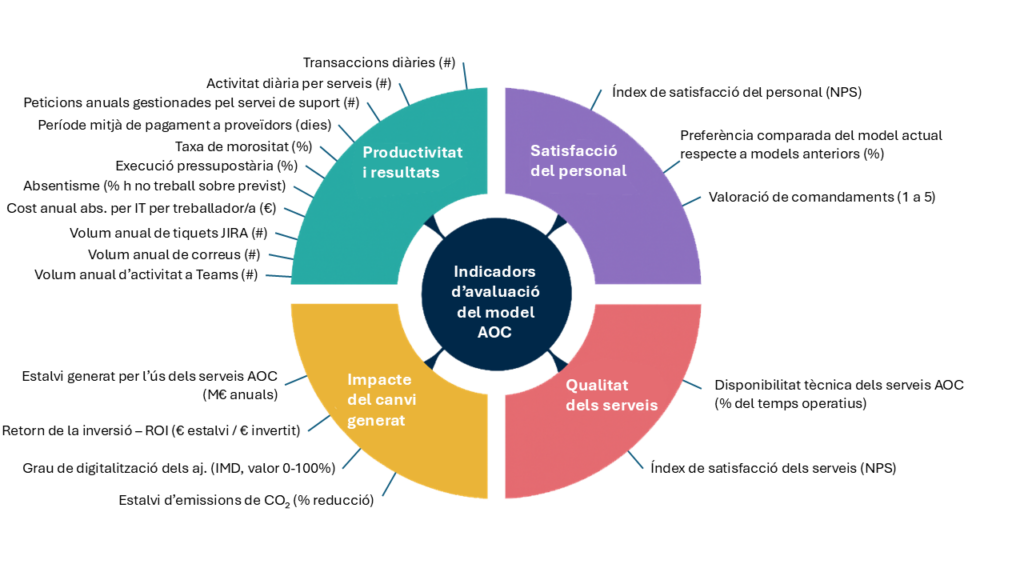
The AOC's hybrid and flexible working model is based on a rigorous and sustained evaluation methodology over time, which allows for regular and comparative monitoring of its evolution. This analysis is based on the set of objective indicators described above, which provide solid evidence for decision-making and guarantee the adaptation of the model to the real needs of the organization.
Every first quarter of the year, the corresponding data is updated, analyzed at the management level and shared with all personnel, sharing the results and assessing, if necessary, the adjustments to be introduced. If the evolution of these indicators shows a significant deterioration, an in-depth review would be carried out to identify the causes and apply corrective measures, including, if necessary, a global rethinking of the model.
Results and impact of the model
Below is a summary of the most relevant results and impacts of the evaluation carried out during the first quarter of 2026. You can consult the complete details of the indicators in the document “Evaluation of the hybrid work model".
Productivity and results
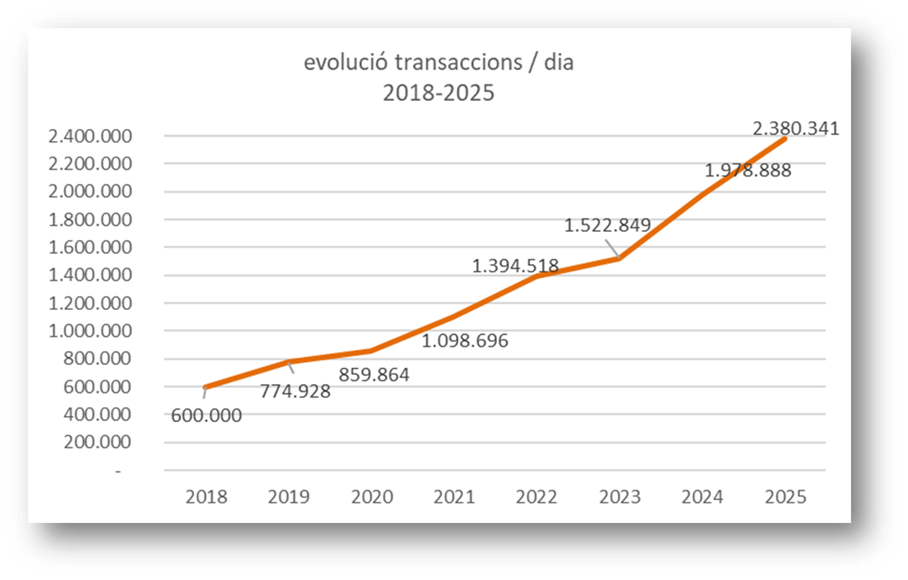
- Sustained increase in service activity and in some cases exponential. It can be seen that the general activity of services in recent years has marked constant growth, as shown in the summary graph below, where representa the total number of daily business transactions. In 2025 it representar an increase of more than 20% compared to the previous year with more than two million three hundred and eighty thousand daily transactions.
- Improvement of the support service for users of AOC services. Since 2020, the year of the pandemic, there has been a significant increase in the number of requests. This 2025 has seen an increase in the number of requests and the main part has been managed using an AI-based chatbot. Regarding service satisfaction, in 2025 there is an increase in the quality perceived by users (NPS), in constant growth since 2023.
- Improvement of internal management and reduction of delinquency. The average payment period to suppliers has been reduced this 2025 to below 9 days, following the constant reduction of recent years. This figure is well below the average for the public sector of the Generalitat de Catalunya. There is also a reduction in default and an improvement in the efficiency of contracting deadlines, as well as an increase in budget execution.
Quality of services
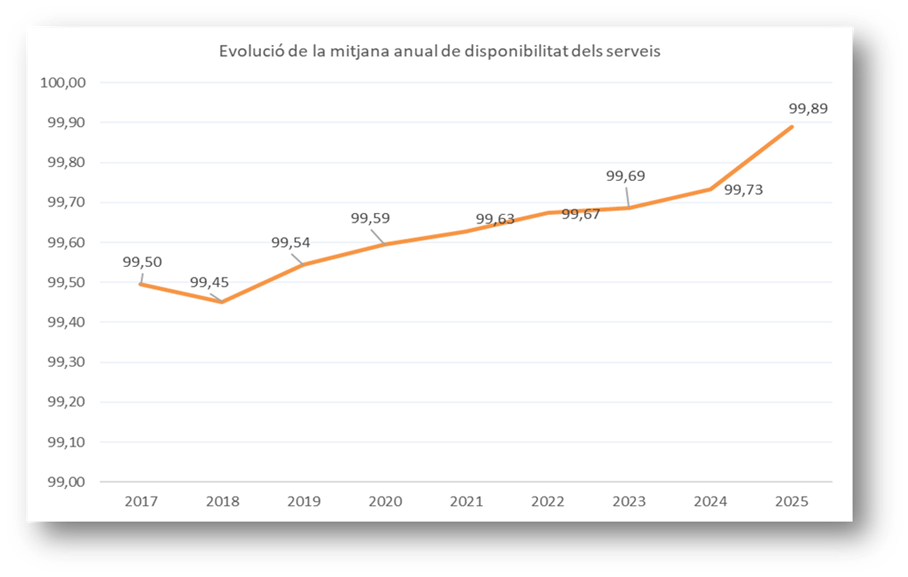
- Average service availability of 99.89%The average availability of services has remained above 99.6% since 2021 and marks a constant increase since 2018, despite the narrow margin for improvement, and reaching record values of 99.89% in 2025.
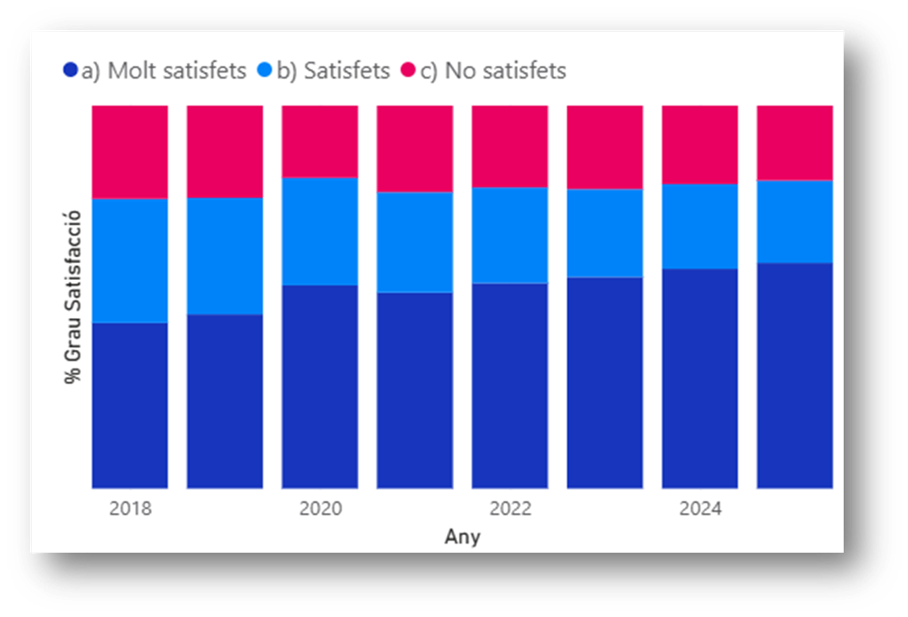
- User satisfaction consistently around 80%It is seen that users who are satisfied or very satisfied consistently exceed 70%, which is considered a remarkable result.
Staff satisfaction
- The current model is highly rated by staff, both in terms of work-life balance and efficiency and work organization. It is also preferred over previous models based solely on in-person or teleworking, and receives a rating of 4,69/5 from the management team and heads of service with responsibility for people management.
Impact of the change generated
- Savings generated by using AOC servicesThe use of AOC services has generated estimated savings of €744 million in 2025, doubling the 2019 figure.
- The degree of digitalization of Catalan city councils has reached 78%. The result of this analysis shows that in 2020, due to the pandemic, there was a significant leap in the digitalization of all local administrations, doubling the value obtained until then. These values have remained stable in recent years at around 78%.
- Decarbonization: The hybrid work model has allowed for a estimated 89% reduction in CO₂ emissions associated with travel.
It is considered that of the indicators reflected in the aforementioned report The AOC's working model is validated as appropriate in the sense that:
- Services continue to grow significantly year after year, with some very notable increases and by 2024 representa a significant leap compared to previous years.
- The evolution in efficiency in internal management improves in general and in some cases significantly, and no areas are identified in which the application of this model requires correction.
- The quality of services has been maintained at levels considered satisfactory without there having been any deterioration associated with the implementation of the model.
- Both the staff and the management team positively value the application of this model, taking advantage of the strengths of both environments: face-to-face and virtual.
However, during 2025 the foundations of the model have continued to be strengthened. These have given rise to an improved version of theAddress, with the collaborative, efficient and safe working model, which supports the organization of day-to-day work.
Among the main changes and highlighted aspects are:
- The construction of a new Intranet, understood as a centralized access point to the organization's work tools and resources. In this way, it is reinforced as a point of reference regarding the latesteres versions of templates and working documents, applications and links; regarding information of general interest; access to the sections of each sub-directorate, areas and specific units; among others. The maintenance of the contents is federated, where each person in charge must keep them updated.
- Emphasizing the obligation for all staff to use corporate tools and in the manner defined as corporate. This affects Teams teams and chats, which act as a daily workspace, allowing fluid communication based on conversations, video conferencing and access to shared documents; the use of documents in the cloud through SharePoint, facilitating collaborative editing and access from any location; the monitoring of projects and tasks with JIRA, which provides visibility into the status of each team's objectives and commitments; as well as the implementation of open agendas, which encourage transparència and coordination and facilitate the organization of meetings and gatherings.
- Strengthen the continuity and regularity of face-to-face meetings with all workers, as well as the promotion of meetings of the different organic or project work groups, and the reinforcement of internal communication with different channels of change management support.
Benefits and conclusions
Once the results of the implementation of the hybrid and flexible model have been carefully evaluated, clear and measurable benefits have been found in the social, economic, environmental and health fields:
- Results-oriented optimizationThe implementation of a measurement and evaluation system through key indicators has allowed the results of the AOC Consortium's activity to be significantly improved, reinforcing operational efficiency and strategic focus.
- Boost to digital administrationTeleworking acts as a catalyst for digital administration and innovation, reinforcing the AOC Consortium's raison d'être and fully aligning with the objectives of the Government Plan.
- Attracting and retaining specialized talentThe hybrid model has become a key factor in attracting and retaining highly qualified profiles in areas such as technology, software development, cybersecurity or data science, improving the competitiveness of the AOC in relation to the private sector.
- Decarbonization and environmental sustainabilityThe environmental impact of work travel has been drastically reduced (from 10,4 tons of CO₂ per month to 1,15 tons), the use of paper has been minimized and natural resources equivalent to the preservation of 7 trees – 175 packs of 500 sheets have been saved.
- Energy and economic savingsInternal consumption (electricity, water, office supplies) has been significantly reduced, with the positive economic impact that this entails for the organization.
- Reduction of costs and time for staffWorkers have seen their transportation expenses reduced and have recovered time previously spent on travel.
- Improving urban and territorial mobilityApproximately 15% of the workforce lives more than 100 km from the workplace, which makes this model viable and sustainable.
- Population redistribution and fight against depopulationThe hybrid model has allowed some of the staff to settle in small or medium-sized municipalities, thus contributing to a more balanced territorial redistribution.
- Improving health and reducing work absencesA decrease in the duration of sick leave has been observed, especially in cases where teleworking has allowed work activity to be maintained without risk to health.
- Reconciliation and self-organizationThe model allows better time management, promotes work-life balance and contributes to workplace well-being, especially in cases of caring for family members or in complex personal situations.
- Contribution to public healthThe structural reduction in mobility positions this model as an effective preventive tool against possible future pandemic scenarios.
This hybrid and flexible model has been consolidated as a strategic tool to guarantee a more sustainable, equitable, efficient work environment aligned with the mission of the AOC Consortium and the country's public policies.
Status of the project
In productionThe methodology is reviewed periodically and the indicators are evaluated annually.
More information
- Guide to collaborative work for public administration, from the AOC Consortium (includes a collection of good teleworking practices, 31/3/2020)
- Results of the employee survey on the in-person/remote work model (with the support of Muutos Consulting) (15 / 07 / 2021)
- Co-creation workshop redefining the AOC's working model (with the support of Muutos Consulting) (26 / 07 / 2021)
Other:
- Quick guide to telecommuting safely - AOC Consortium(18 / 3 / 2020)
- Results of the survey on tools for collaborative remote working (29 / 3 / 2020)
- The normality of teleworking in the AOC (29 / 5 / 2020)
- THE IRRUPTION OF COVID-19 AND THE DISRUPTION OF WORK: Teleworking, Meritxell Vargas, for Mujeres in the Public Sector (2/6/2020)
- Digital Government Moments: New ways of working in the administration (23 / 11 / 2020)
- Product The workspace and new forms of local management, by Marga Bonmatí for the EAPC, (12/4/2021)
- Communication “The teleworking experience in the Open Administration of Catalonia” by Miquel Estapé, for the Institute for Knowledge Transfer in Public Innovation (ITCIP) (24/6/2021)
- Mobile work user guide, from the Telecommunications and Information Technologies Center.
- Digital transformation manual for public employees, from the Department of Digital Policies and Public Administration of the Generalitat de Catalunya.
- AOC Blog: “AOC's hybrid and flexible work model promotes efficiency, agility and work-life balance” (2 / 9 / 2025)
Nota
It is worth noting that this work model has been implemented in a medium-sized organization (85 people), which does not offer face-to-face services and is highly digitalized. This entity also has a consolidated culture of collaborative digital work and a staff with medium-high level technological skills. Its application in organizations with different characteristics would probably require adaptations.