

From digital support to technological sovereignty: the AOC roadmap for the local world


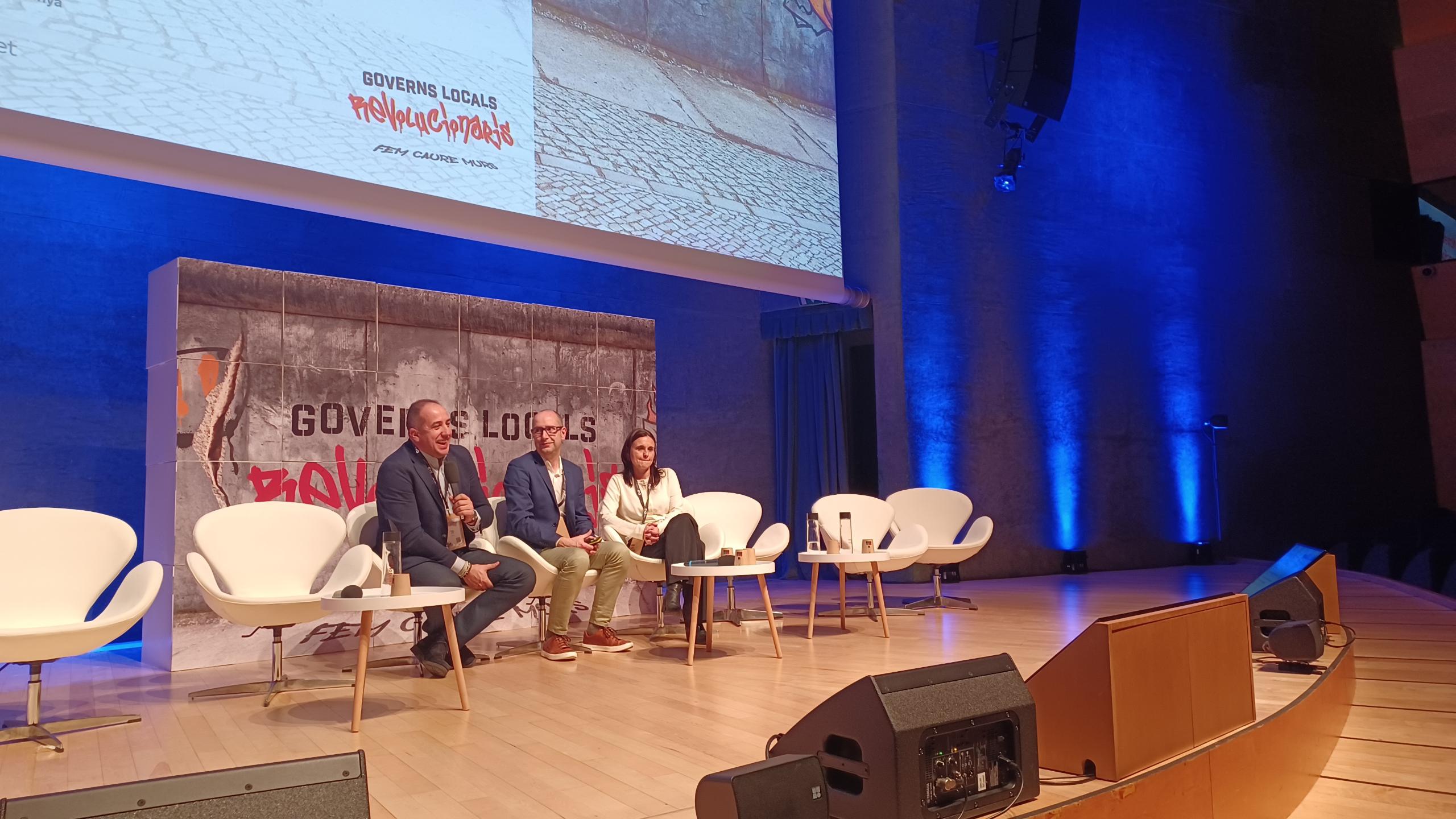
On March 17, as part of the conference “Revolutionary Local Governments”, the AOC presented a joint session with three complementary perspectives on the present and future of digital transformation in the local world.
The session, led by the head of the Accompaniment and Training unit, Carlos Rodriguez, the head of the Territorial Advisory and Deployment unit, Beatrice Tudel and the Deputy Director of Digital Transformation, Pep Budí, focused on supporting local administrations in digital transformation by promoting new models, proximity, active listening and training, placing people as the true protagonists of change.
Recent advances, common working models and technological challenges faced by Catalan administrations were presented.
Carlos Rodriguez opened the session by explaining the profound transformation of the AOC's care model. The new approach aims to accompany and train, not just resolving incidents. This implies closer attention, adapted and focused on the real needs of each person or public entity, promoting their autonomy in the medium term.
This new model is based on four fundamental axes:
Rodríguez also highlighted the impact of this change during the 23-25 period, which despite increasing digital transactions, requests for assistance have been decreasing (-29% in 2024 and -25% in 2025), thanks to the reinforcement of support resources and the use of technologies based on generative AI, which allow us to automate processes, anticipate needs and improve the quality of the response.
In the final part of his presentation, he announced four outstanding new features that will be rolled out soon:
These developments are included in the roadmap that foresees the consolidation of the model throughout 2026 and the full launch of the service with all these elements in 2027.
Beatrice Tudel explained how the AOC works in a coordinated manner with provincial councils, county councils and other key actors of the territory. He highlighted the desire to strengthen this territorial presence, enhance synergies, detect needs and align digital services with them. This collaborative model contributes to guaranteeing equity and digital and territorial cohesion, and facilitates a homogeneous implementation of solutions in all local entities.
One of the central themes of his speech was theEset, presented as a common and agreed model of electronic processing. TheEset allows:
His presentation conveyed a clear message: digital transformation is only possible if it is carried out jointly, sharing criteria and resources and promoting models efficient, standard and common.
The session closed with the intervention of Pep Pudding, which analyzed the main risks and opportunities of the current technological context. Budí warned about the growing concentration of the ICT market, which especially affects small municipalities and can lead to excessive dependencies, price increases or situations of lockin technological.
Faced with this scenario, he defended the need to move towards a digital sovereignty model, with a framework that guarantees:
A significant part of his presentation was dedicated to local government information systems (SIAL), a common and standard reference framework, which allows ordering the technological model by facilitating both the development of new solutions and their contracting, promoting quality, facilitating integrations and promoting an open ecosystem that allows the participation of emerging companies and co-development models.
Pep Budí emphasized a key message: public or publicly controlled alternatives are needed that guarantee stability, strategic control and long-term sustainability for the local world.
The joint session demonstrated that the digital transformation of the local world requires proximity, shared model i technological sovereigntyThree complementary perspectives that, added together, point in the same direction: a more robust, efficient and public service-oriented digital ecosystem.
You can recover the video of the session and the presentation.