

The director of the AOC shares the vision and future challenges at the Open Administration Recognition event


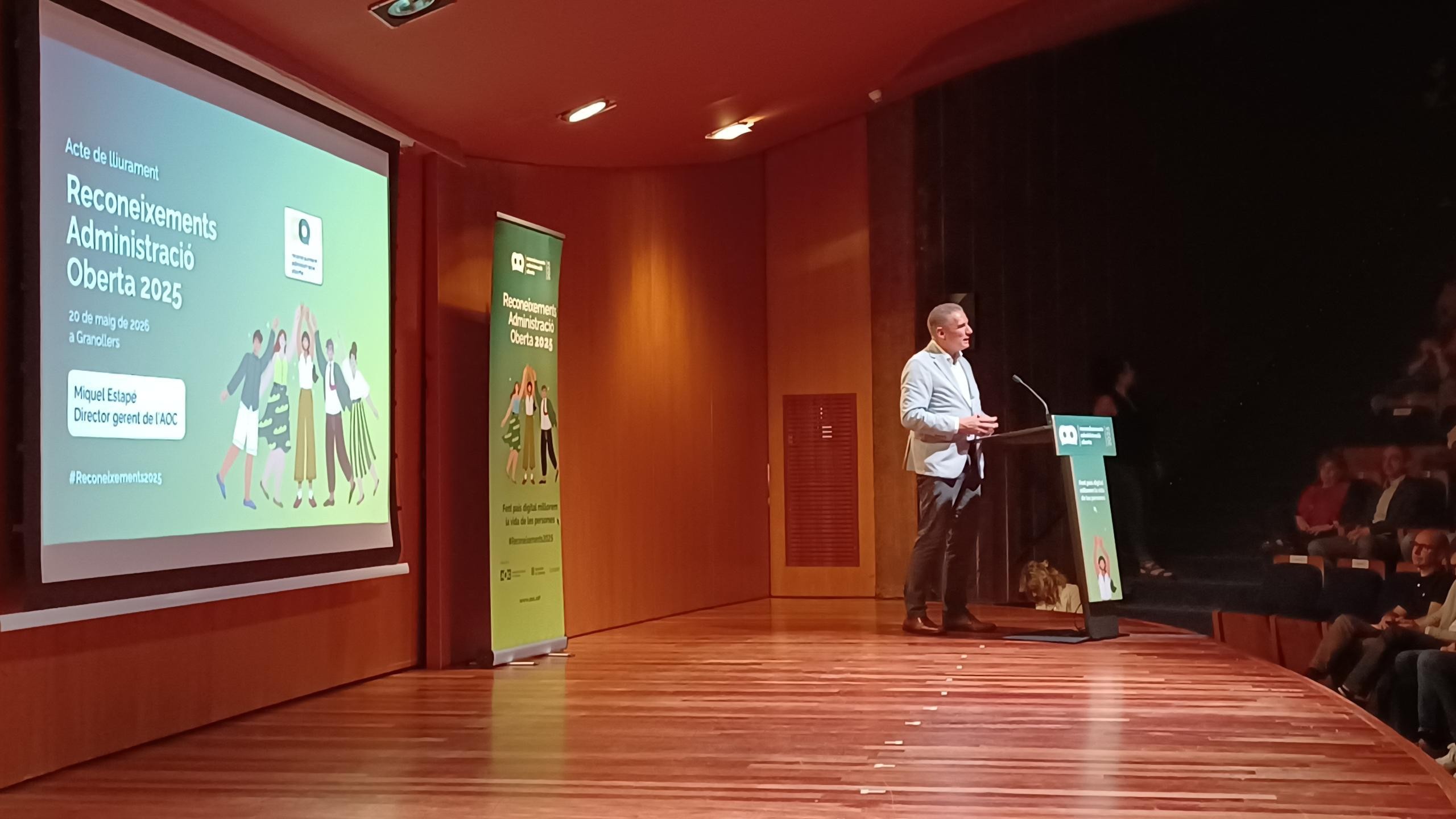
During the Open Administration Recognitions 2025 event, Miquel Estape, director of the AOC, stressed the importance of evaluating to improve and shared the vision and main challenges that correspond to us to advance, together, the country's digital public services.
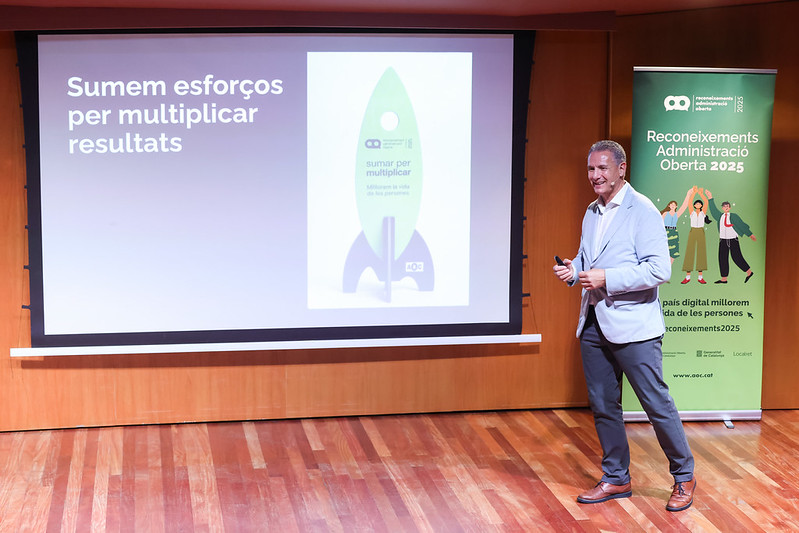
The director emphasized that these recognitions are not an award that "touches you", but the tangible result of daily work sustained over the last twelve months. They constitute, therefore, an act of justice that gives visibility to the commitment to public service of the city councils and county councils that lead the effective deployment of digital administration and open government.
This recognition, however, also entails a responsibility. The awarded entities lead the digital transformation of the local public sector in Catalonia: they make courageous decisions and become a reference for the rest. However, there are many other administrations that, for various reasons, find it difficult to advance at the same pace. The shared responsibility consists of identifying, through the Digital Maturity Index, the most innovative initiatives and replicable good practices, so that no administration is left behind on this path.
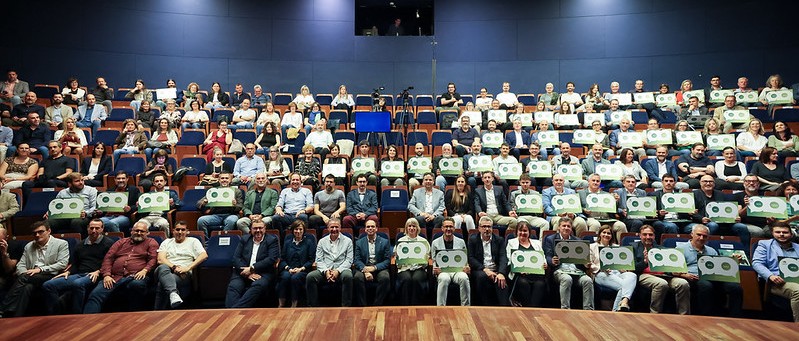
The director specified the role of the AOC Consortium in this ecosystem: to offer common solutions for shared problems, with the aim of ensuring that no administration is left out of the digital transformation. Beyond technological services, the AOC collaborates, cooperates, shares and coordinates to avoid duplication and to multiply the impact of technology and accumulated knowledge.
This task is not done alone: it is carried out in close collaboration with the Government of the Generalitat and, very especially, with the provincial councils, a key piece for the system to function and reach every corner of the country.
Evoking Lord Kelvin's famous maxim, the director stressed that without quality data one cannot evaluate and without evaluation one cannot improve. This is the essence of the Digital Maturity Index: a pioneering tool on a European scale that collects and crosses information from very diverse sources.
Very valuable lessons emerge from this meticulous work. Three pieces of good news stand out: 80% of citizens declare themselves satisfied or very satisfied with local digital services; the use of these services generates an average saving estimated at around 100.000 euros per town hall —a figure validated by the methodology developed by the AOC itself—; and 70% of the requests received by local entities are already digital, a proportion comparable to sectors as advanced as banking.
There are, however, two areas that need a clear boost. The first is compliance with the Law on transparència, still at 55%: a demanding standard that applies the same level of requirement to a municipality of fifty inhabitants as to the city of Barcelona, and that calls for shared reflection. The second is interoperability —the principle according to which citizens do not have to present documents that are already in the possession of the administration—, which remains at 31% of its potential. The recent episode of the queues generated by the process of regularizing foreigners has shown that we have a lot of work to do.
With an eye on the future, the director announced the desire for the Index to evolve towards a true maturity index of digital transformation. While digitalization measures the extent to which processes have moved to the digital world, digital transformation evaluates the real impact on citizens and on the internal efficiency of the administration. Dimensions such as digital rights, the digital divide, processing times, new cybersecurity indicators, personalized citizen satisfaction by administration and institutional quality will be progressively incorporated into the metric over the coming years.
One year after the signing of the agreement between the Government of the Generalitat, Localret, the four provincial councils and Barcelona City Council, the director took stock of the work carried out by the Smart Governments network. This alliance pursues a clear objective: to ensure that any local entity in Catalonia —however small it is and however limited its resources are— can take advantage of the opportunities of data and artificial intelligence to improve the public services it provides to citizens.
Over the past few months, the working groups have made progress in building a common data platform, defining a governance model that guarantees quality and traceability, developing a framework for the ethical and responsible use of artificial intelligence — with dozens of use cases identified — and training public workers.
The message addressed to local entities is clear: that technological complexity be assumed by the network, and that city councils and county councils can concentrate all their value where they are irreplaceable — in identifying the real problems of the territory and in making decisions rooted in proximity and knowledge of people.
There are already tangible results: the Smart Governments website, a resource catalogue under construction, a common data platform in the testing phase, use cases promoted by the Girona Provincial Council in the automation of plenary sessions, a report on the digital divide prepared with the Taula del Tercer Sector, and new cases on energy consumption of municipal buildings, interoperability and sustainable development objectives. In the specific field of generative AI, the AOC is promoting solutions such as the automatic anonymization of documents for portals transparència and the intelligent classification of the more than two million generic instances managed each year throughEACAT and e-TRAM.
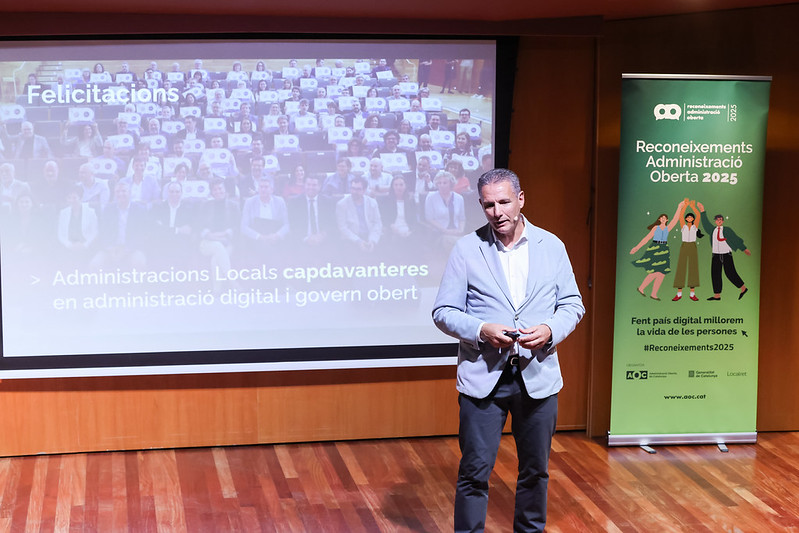
The director framed all this work within a broader conviction: we are living in a time of digital revolution that demands structural reforms, not simple adjustments. In this sense, he welcomed the initiative of the Government of the Generalitat to propose an ambitious project to reform the Catalan public administration.
The AOC, in its field, is also immersed in a reform process. The new statutes of the Consortium, the result of a year and a half of work with the Government and with the local world through Localret, redefine the governance, mission and objectives of the entity with a notable generosity from all parties. Three pieces underpin this renewal. First, a reinforcement of the governance of the local world: the provincial councils will have a direct presence in the executive bodies of the AOC, a crucial decision if we bear in mind that they represent 93% of the country's town councils.
Secondly, a new shared financing model: the Generalitat will continue to assume the structure and investment -around 80% of the cost-, while the local community will contribute based on effective use, through a marginal cost -that is, only the additional cost generated by each use of the service. This new financing model, which will soon be formally communicated, responds to a political will of the governing bodies of the AOC and to the intervention reports, which recall that consortia are collaborative entities in which the parties that benefit from the services must contribute to their maintenance.
And, thirdly, an update of the mission and functions that consolidates the provision of new common services in areas such as data and artificial intelligence.
The director wanted to explicitly acknowledge the provincial councils, which have been offering assistance, technological solutions, training, advice and support to the local world for many years. The AOC, he said, learns from them and jointly identifies in which areas the economy of scale is found at the country level. He also launched an open reflection: the local world increasingly demands common solutions regardless of the size of the municipality, and this forces us to rethink together the areas of shared services.
The example of the portal transparència is very illustrative: a solution initially designed for small municipalities that is now used by both Sant Jaume de Frontanyà —the smallest municipality in Catalonia— and the City Council of l'Hospitalet —the second largest city in the country—. To achieve this, it is necessary to design services with a vision of flexibility, scalability and a common service vocation.
Regarding the county councils, the director strongly claimed their role as local support, the zero kilometer of the digital transformation. Small municipalities need, now more than ever, accompaniment and support in the technological field, but also in digital administration, open government, transparència, data protection, accessibility, plain language and others. The regional councils, coordinated with the provincial councils, are the ideal entity to help share the operational management of the services associated with the digital transformation. He stated that a joint strategic reflection is needed to organize and strengthen this function, currently dispersed between different agreements with the Generalitat, the AOC and the provincial councils.
The motto chosen for this edition —Add to multiply— structured the final message. Taking as a reference the recent NASA space mission, Artemis II, which has brought humanity back to the Moon, the director recalled that the values necessary to achieve a milestone of this magnitude are exactly the same as those required by the digital transformation of the public sector: shared vision, collaboration, passion for public service and generosity between the parties. It is by joining efforts that we will multiply the impact of each administration in the service of the citizenry.