

Spain confirms its European leadership in connectivity and digital public services


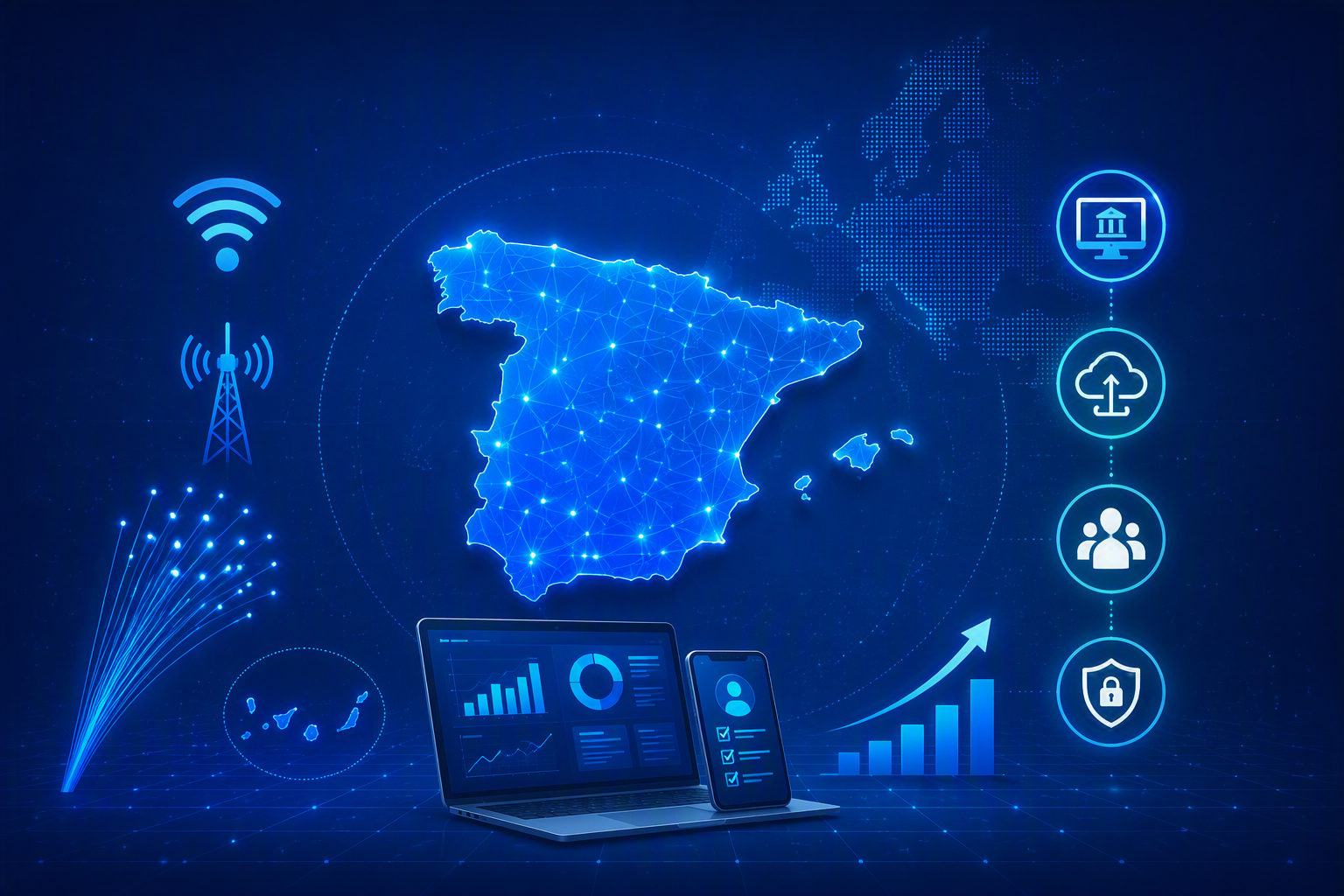
Spain remains among the leading countries in the European Union in terms of connectivity and digital public services, according to theState of the Digital Decade Report 2026 published by the European Commission.
The report highlights that Spain exceeds the European average in key areas such as connectivity, the digitalization of SMEs, the digital skills of citizens, the adoption of artificial intelligence and data analysis, as well as the availability of digital public services.
Spain continues to lead European connectivity indicators. It is the country with the highest proportion of internet connections of 100 Mbps or higher and ranks second in fibre optic coverage. This reaches 96% of the population, well above the European average of 74%, while in rural areas coverage is close to 89%, compared to 63% in the EU.
The deployment of 5G networks, which already cover practically the entire population, in both urban and rural environments, also stands out. The European Commission also values investments in submarine cables, which consolidate Spain as one of the main digital connectivity hubs in southern Europe.
The digitalization of the Administration continues to be one of the strengths of the State. Spain obtains a score higher than the European average in both digital services for citizens and for businesses.
The report highlights efforts to offer more accessible, integrated and user-focused services. Among the highlighted initiatives is Mi Carpeta Ciudadana, which continues to expand functionalities and services to facilitate citizens' relationships with public administrations.
The Commission also highlights the good results in the use of pre-filled forms, which allow the reuse of data already available to the Administration and simplify procedures. In this indicator, Spain is among the top three European countries.
The report recognizes Spain's strategic commitment to quantum technologies, with initiatives aimed at strengthening European competitiveness and technological autonomy.
Among the most relevant actions is the Quantum Technologies Strategy 2025-2030, as well as investments aimed at developing specialized talent, advanced infrastructures and scientific and industrial capabilities in this emerging field.
The adoption of artificial intelligence continues to grow strongly. By 2025, one in five Spanish companies was already using this technology, a figure slightly higher than the European average.
The implementation of data analysis tools is also increasing, while small and medium-sized enterprises continue to advance in their digital transformation process. According to the Commission, programs such as Kit Digital, Kit Consulting and Acelera Pyme have contributed to this positive evolution.
66,5% of the Spanish population aged 16 to 74 have at least basic digital skills, a proportion higher than the European average. The report notes that these results are found in both urban and rural areas and highlights in particular the advances among young people, the elderly and in digital security.
The Commission also values initiatives aimed at promoting digital training for citizens and raising awareness of cybersecurity.
Finally, the report recognizes the efforts made to strengthen the country's cybersecurity and digital resilience. During 2025, prevention, detection and incident response capabilities continued to be expanded, while progress was made in the application of the main European regulatory frameworks in this area.
Overall, the Report on the State of the Digital Decade 2026 confirms Spain's good position in achieving the European digital objectives for the year 2030 and demonstrates the advances made in both infrastructure and services, skills and strategic technologies.