

Agent.IA is presented at the Smart City Expo, the public and shared platform for the local world


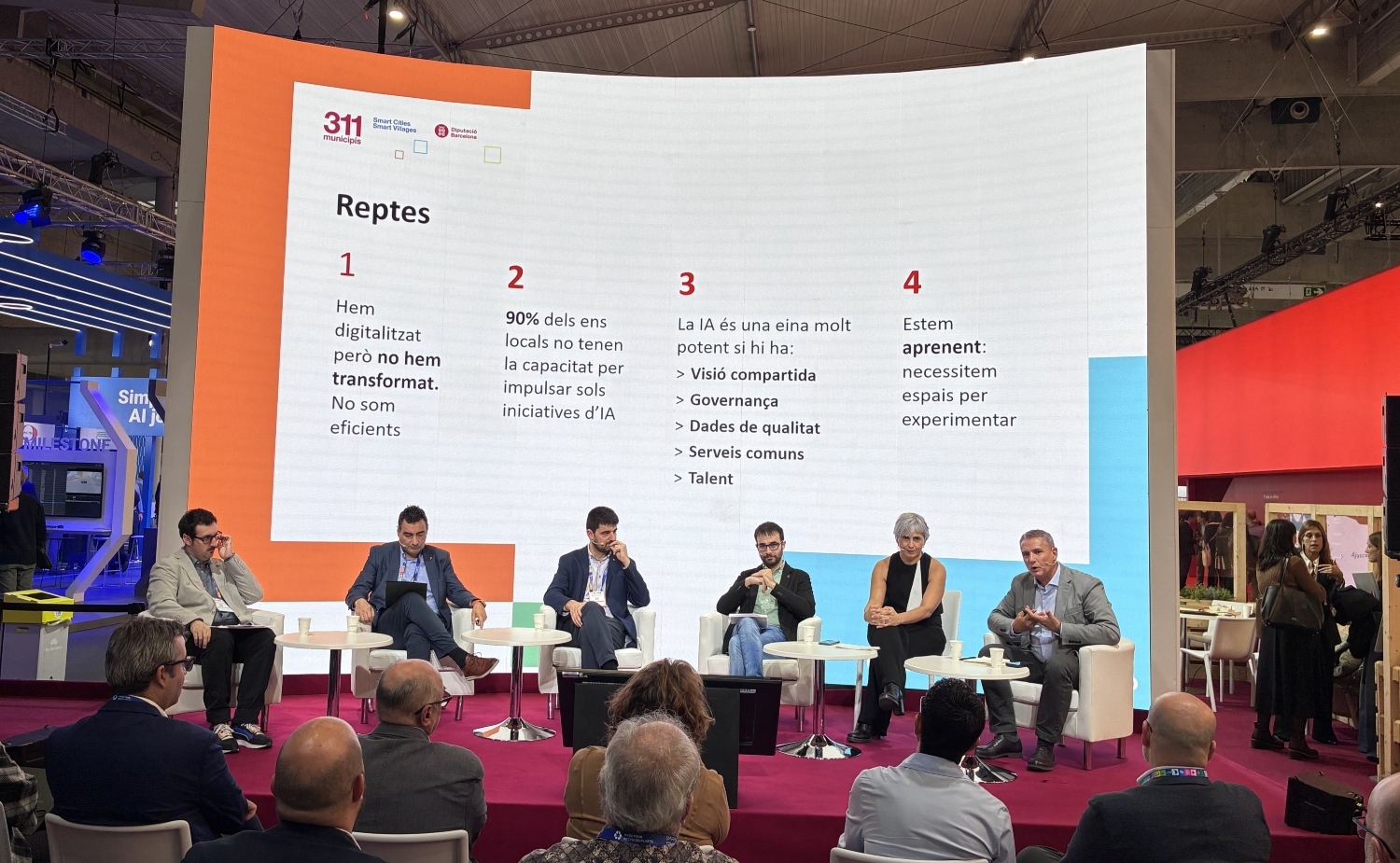
The provincial governments of Barcelona, Girona, Lleida and Tarragona and the AOC Consortium have presented this November 3, within the framework of theSmart City Expo World Congress, the collaboration model with which Catalonia wants to promote the adoption of artificial intelligence in the local world, articulated around two complementary initiatives: Local.IA, the shared strategy of knowledge, methodology and governance, and Agent.IA, the technological platform that allows experimenting and deploying AI solutions with guarantees.
The presentation put on the table a shared challenge: how to ensure that all local governments, regardless of their size and capacity, can take advantage of artificial intelligence to transform public services and improve citizen care.
The answer is based on an experience that has already been successfully applied in digital transformation: build once, share with everyone. The collaboration between the provincial councils, the AOC and the local community has made it possible today, in a small municipality, to electronically process or access public information on the portal of transparència be as easy as in a big city. Now the challenge is to transfer this same shared model to artificial intelligence.
The proposal is to share knowledge, data, infrastructure, methodology and solutions. It is not about each city council building its own AI, but rather creating the conditions so that everyone can use it with guarantees.
AI comes at a time when public administrations have made great progress in digitalization, but they still have significant room for transformation. Digitalizing a procedure does not necessarily mean making it simpler, faster or more efficient. There are still processes such as processing social assistance, building permits or requests for access to public information that maintain much of the complexity of years ago.
This is where AI can provide a qualitative leap. But technology, on its own, does not transform an organization. It can accelerate and catalyze change, but for this change to be real, governance, quality data, shared resources, talent, new organizational models and a common vision are needed.
For this reason, Agent.IA is not just a technological project, but a collaborative initiative and shared infrastructure to accelerate the transformation of the local world.
One of the most unique elements of the initiative is precisely its governance model. The experience of other countries and communities shows that public AI projects tend to be led by an administration that develops solutions that can then be used by other organizations. The Catalan model wants to go further: administrations at different levels share vision, knowledge, data, resources and solutions from the beginning.
It is an ambitious commitment and also an invitation to learn together. Innovating means experimenting, comparing results and assuming that not all tests will work the first time.
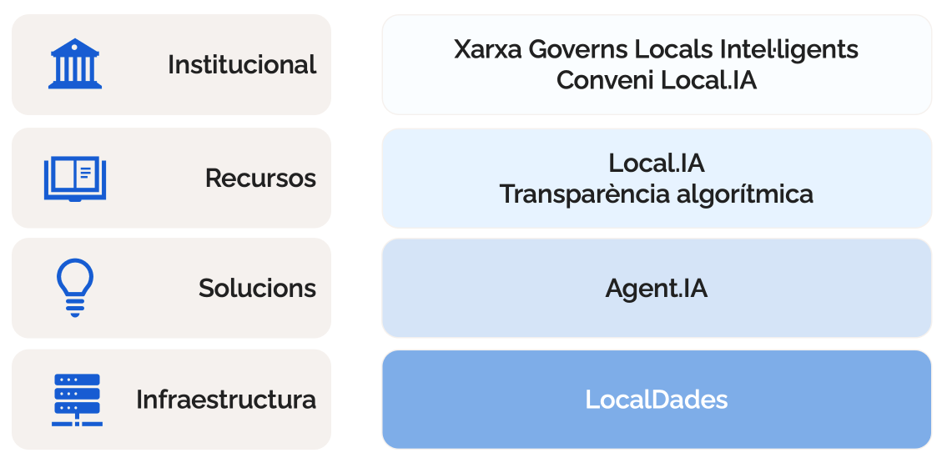
The model is being progressively built on four layers. The first is institutional: having stable agreements and spaces for cooperation, such as the Smart Local Government Network or the most recent agreement of Local.IA collaboration between the four provincial councils.
The second is shared resources: methodology, training, guidelines, best practices and experiences. The third is the shared AI solutions platform, with tools that allow experimenting, validating and deploying artificial intelligence solutions in an agile and secure way.
And the fourth is the common technological and data infrastructure, which guarantees data governance and quality.
Local.IA is an ecosystem of shared resources to support municipalities in the implementation of AI: training for elected officials and technical staff, methodology and guidelines for evaluating use cases, document models, best practices and a community to share experiences. The goal is that no municipality, no matter how small, has to face the questions raised by AI alone.
All of this from a public, safe, sustainable and ethical model: public, because leadership and control are from the administrations; safe, because it protects data and people's rights; sustainable, because it shares costs and prioritizes efficient solutions, and ethical, because it puts the transparència algorithmic and the principles of the European Regulation on artificial intelligence.
Trust is an indispensable condition for AI to be incorporated into public services.
Therefore, before putting a use case into production, the proposal is to prepare reports transparència algorithmic that systematically analyze the rights and principles that need to be guaranteed, the risks, potential and impact of the solution, the necessary mitigation measures and the monitoring and supervision mechanisms.
It is not enough for a system to work. It is necessary to be able to demonstrate that it works with guarantees. This involves generating tests and evidence, establishing periodic controls and monitoring its behavior over time. This methodology allows us to move from experimentation to real services, reducing risks and building trust between administrations, public professionals and citizens.
Agent.IA wants to offer local administrations a shared environment where they can experiment with different artificial intelligence technologies and models before incorporating them into their services.
This approach allows you to learn faster, share what works, and reduce the cost and risk of individual experimentation.
It also allows us to evaluate different types of models, both commercial and public and open, and analyze in each case which alternative offers a better balance between functionality, security, privacy, autonomy and sustainability.
The purpose is not to have a single technology, but to build a shared public capacity to experiment, learn and deploy AI with guarantees.
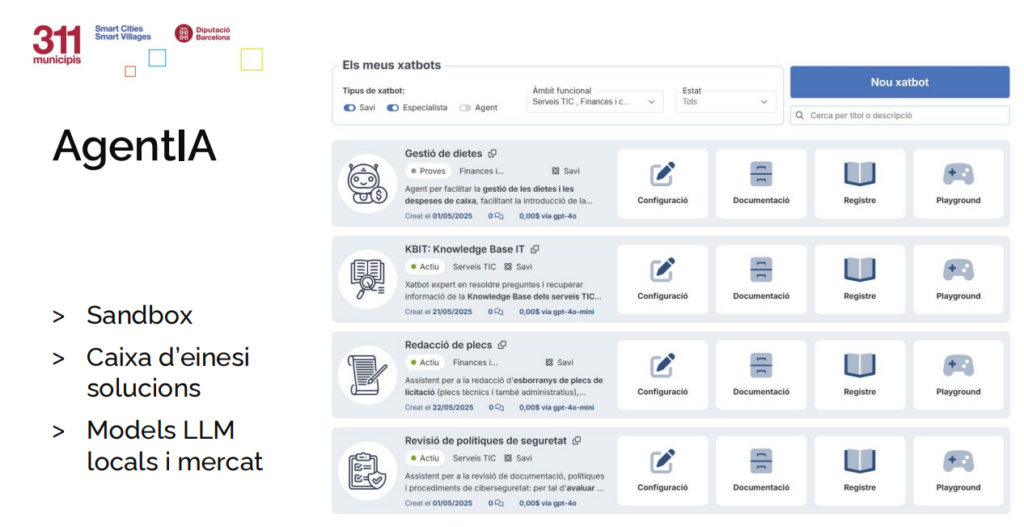
The first identified use cases show the practical potential of this approach.
One of the most obvious is to make it easier for citizens to find and understand administrative information through intelligent search engines and virtual assistants.
But the possibilities go much further. In regulated procedures such as recruitment, subsidies, personnel management or social services, AI can help automate repetitive tasks and support both citizens and public professionals. For example, before a person submits an application, the system can warn them that a document is missing or that a requirement should be verified. At the other end of the procedure, it can help the public employee review the documentation using a checklist.
The objective is not to replace the judgment of the public professional, but to increase their capacity and free up time for tasks that add more value.
This entire model needs an essential foundation: reliable, well-governed and reusable data.
For this reason, Agent.IA is linked to LocalDades, a shared local data platform that allows information to be managed and governed, its quality to be guaranteed and a catalogue of validated data products to be progressively available.
This shared infrastructure is especially important for municipalities with fewer resources.
The challenge of the coming years is to consolidate a reference space for all local administrations that allows sharing three fundamental assets:
And with an additional conviction: innovation does not depend on size or hierarchy. In the local world there are small municipalities experimenting with local models of artificial intelligence and developing solutions that may end up being useful for the system as a whole.
Therefore, the goal is not only for small administrations to be able to take advantage of the solutions of large ones. It is also to create an ecosystem in which a good idea arising in any city council can scale and benefit the entire local community.