Agent.iA: Catalan provincial governments and the AOC test whether an ethical, sustainable local AI based on public models is possible
Share
The four provincial councils and the AOC Consortium are working together on 10 proofs of concept with artificial intelligence assistants and agents for local administration under the principles and methodology of Local.iA. To do so, they have the support of Think UPC and Coloq.iA, a shared AI platform deployed on the AOC infrastructure and operated under the public supervision of the Consortium.
That artificial intelligence can automate procedures, provide support and guide citizens in processing a service or review documents is already a fact. What has not yet been demonstrated is whether it can be done with public models, ethically and sustainably, both in terms of the environment and the economy. This is the question it wants to answer Agent.iA, the project shared by the provincial governments of Barcelona, Girona, Lleida and Tarragona and the AOC Consortium.
“Are we capable of creating AI solutions for the local world that are sustainable, environmentally and economically, and based on public models?”
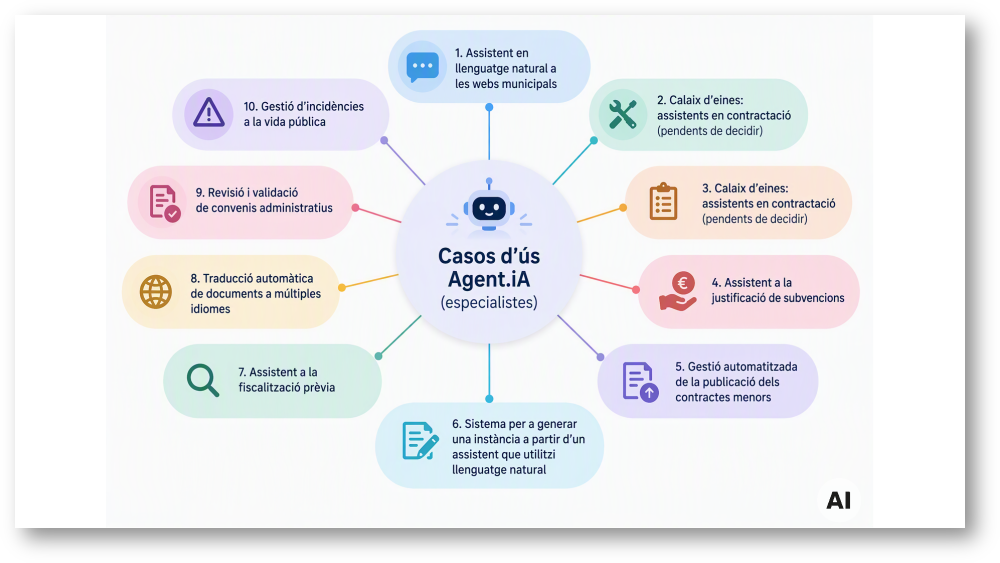
To answer this question, the project will work over the next few months on the design, development and evaluation of 10 proofs of conceptThe goal is not just to make them work, but to check if they work while respecting the values that drive Local.iA.
Local.iA is the project promoted by the Catalan provincial councils that aims to deploy a public, ethical, sustainable, safe and responsible AI.
Ten use cases chosen based on shared needs
The four provincial councils have jointly selected the 10 use cases based on the challenges that are most common in the country's city councils and local bodies. Among others, they include:
Assistants who facilitate citizens' access to municipal information.
Public procurement support tools.
Systems to streamline grant management.
Generation of instances from natural language.
Review of administrative agreements.
Automatic classification of incidents on public roads.
What will be assessed?
Each proof of concept will be analyzed from several perspectives:
Technical feasibility with public AI models.
Sustainability, both in economic cost and environmental impact.
Ethics and human rights, including adaptation to the European Regulation on artificial intelligence.
Real utility and impact on the work processes of organizations.
A model of co-creation between administrations
The initiative is developed through a collaborative governance model. The use cases are worked on by multidisciplinary teams made up of professionals from the four provincial councils and the AOC Consortium with very diverse profiles: technological, legal, organizational, process management, contracting, data governance or citizen services, among others.
The AOC provides the project's shared AI platform: a single platform, under public supervision, that serves the four provincial councils without each having to deploy and secure its own. To this end, it has deployed Coloq.iA, developed by Think UPC, on its infrastructure. Think UPC accompanies the process of co-creation and evaluation of the solutions.
This working model will allow us to pool knowledge, experiences and shared needs to build solutions that can be reused and scaled up throughout the local world.
A public AI within the reach of all local entities
Agent.iA is part of the Smart Local Government Network (XGLI), which aims to promote a common infrastructure of data and AI services for the local world. The aim is to ensure that all local entities, regardless of their size, can access advanced tools that contribute to improving public services and the efficiency of organizations.
The provincial governments of Barcelona, Girona, Lleida and Tarragona and the AOC Consortium have presented this November 3, within the framework of the Smart City Expo World...
The III DPD Online Meeting allowed the AOC to present the progress of the report transparència algorithmic (TRAL) and contrast its approach with protection professionals...