

The AOC participates in the 1st Conference on Data Governance in the Local Area in Salou


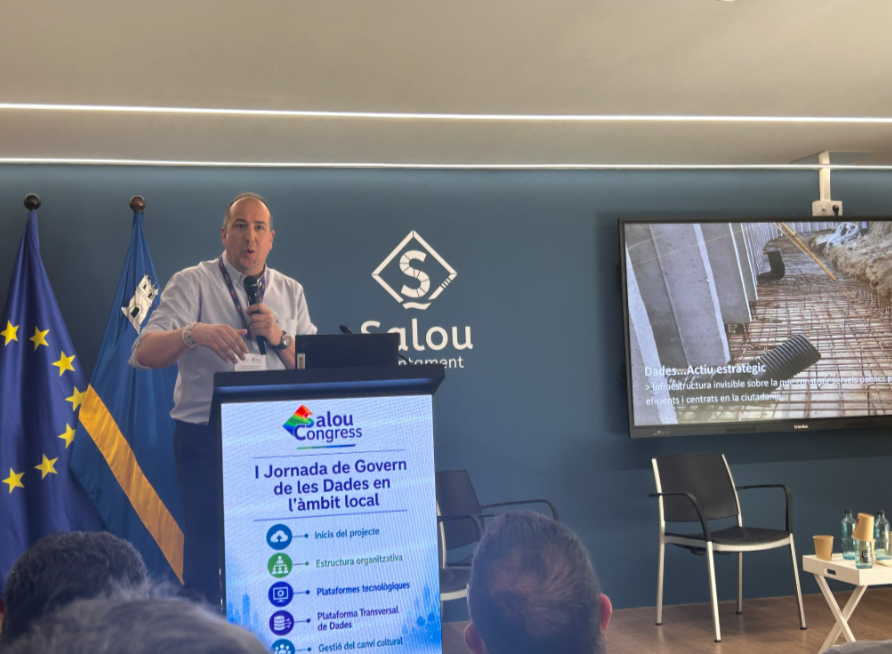
The past 12 in June of 2026, Salou hosted the I Conference on Data Governance in the Local Area, a meeting promoted by the Data Office of the Salou City Council with the aim of creating a space for exchange between local councils and administrations that are already deploying or considering promoting data governance projects. The event brought together profiles linked to local data offices, those responsible for governance and data management projects and professionals involved in the digital transformation of the local world.
This session focused on a shared challenge: how to turn data into a real public management asset, useful for improving services, facilitating decision-making, strengthening transparència and move towards smarter, more efficient and closer local administrationseres to the citizenry.
The core of the session was a round table of real experiences led by Juan David Cermeron, from the Prat de Llobregat City Council, Anna Quer, from the Mataró City Council, Gumer Guijosa, from Sabadell City Council, Xavier Panisello, from the City Council of Solou and from Felipe Ruiz, from Tarragona City Council.
The debate addressed key issues such as the origin of data governance projects, the organizational fit of data offices, the role of their managers, the technological platforms that make both cross-functional governance and management possible, technological models, data culture and internal training.
Experiences that helped event participants visualize how to land these types of initiatives and projects in their organizations to transition towards data-driven and data-led organizations.
One of the most relevant elements of the day was to confirm that data governance is not just a technological issue. It requires strategic vision, leadership, clear organizational models, defined roles, common criteria, information quality and an internal culture that understands that data is part of the ordinary functioning of the administration.
The AOC's participation in the conference is part of the desire to promote, together with local entities and supramunicipal administrations, a shared model that facilitates the adoption of data governance in the local world. The challenge is especially important for small and medium-sized municipalities, which often do not have specialized teams or sufficient resources to deploy their own data governance and management structures.
The Deputy Director of Digital Transformation of the AOC, Pep Budí shared the project and data products that are being worked on in the new Data and AI Platform for the local world with the aim of providing value through end-to-end data services and artificial intelligence and becoming a reference space for cooperation, standardization and provision of common services. In this context, it is necessary to move towards reusable models that help local entities organize their data, improve its quality, facilitate interoperability, generate useful indicators and have shared tools that allow information to be transformed into knowledge for public decision-making.
The conference also allowed for sharing of views on cross-platform data, information ingestion, ETL catalogs and repositories, and the relationship between internal data, third-party data, and territorial information. This area is especially relevant for the local world, where heterogeneous information systems, different technological contracts, and unequal capacities often coexist depending on the size of each entity.
There was also a debate on the use of open source or proprietary technologies, as well as cloud or on-premise deployment models. This debate connects directly to the need to ensure the digital sovereignty, avoid excessive dependencies on suppliers and promote interoperable, sustainable and reusable architectures.
Another of the highlights was the importance of culture and training. Governing data implies that public organizations understand what they have, where they have it, who is responsible for it, what quality they work with and what they want to use it for. This requires training both technical profiles and business profiles, because data is not only the responsibility of ICT departments, but of the entire organization.
The 1st Conference on Data Governance at the Local Level was a first step to share experiences, identify common challenges and begin to build a community of practice around data governance. The value of the meeting lies, above all, in having shared real cases, specific difficulties and learnings applicable to other local administrations.
From the AOC we will continue working to promote common services, models and criteria that enable all local entities, regardless of their size and technical capacity, to move towards more data-based, more efficient, more transparent and more citizen-oriented public management, hand in hand with the local world, and therefore, facilitating, connecting and collaborating with initiatives such as those last June 12 in Salou.