

From the adoption of AI to augmented administration: the AOC at ICT Day


Artificial intelligence has already entered public administrations. The challenge, however, is not to adopt it, but to take advantage of it to transform the Administration and offer more efficient, agile, proactive services adapted to the needs of citizens.
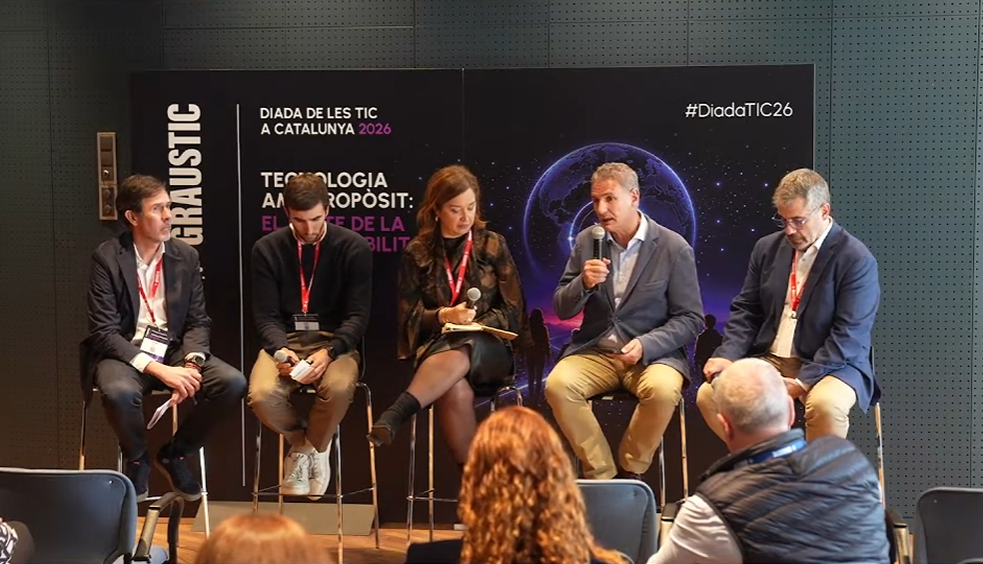
This was one of the central ideas of the intervention of Miquel Estape, director of the AOC, at the table "Augmented Administration: how will we govern in the era of AI?", of the ICT Day in Catalonia 2026. The session was moderated by Andrew Francisco, director of the Localret Consortium, and participated in Yolanda Linares, general director of Corporate Strategy of the Hospitalet de Llobregat City Council; Richard Leal, Director of Public Sector at Salesforce, and Albert Iruela, CEO and co-founder of Omnios.
Governments are already experimenting with assistants, automating tasks and launching pilots. But adopting AI is not the same as transforming the government with AI.
We have already experienced a similar situation with digitalization. We have reached a very high level of digitalization, in many areas higher than that of the private sector, but we have digitized more than we have transformed. We have often moved procedures designed for paper to the internet: windows converted into forms, papers into PDFs and handwritten signatures into electronic ones. All of this was necessary, but it has not always led to simpler, faster or more innovative services.
With AI we can repeat the same mistake. Adopting it means applying it to current processes to summarize documents, produce reports or answer queries. Transforming with AI means reviewing whether these processes still make sense, simplifying them and imagining new, more personalized and proactive services.
The goal is not to do what we already do faster, but to reimagine how we deliver public services.
If we apply AI to the same procedures, structures and rules, we will have a more automated, but not necessarily transformed, administration. The barrierseres The main ones are organizational, cultural, legal, data and governance.
Administrations are organized by competencies and procedures, while people's needs are cross-cutting: having a child, opening a business, requesting assistance or moving house. Transforming requires organizing services around these needs, simplifying, sharing data, reviewing responsibilities, training professionals and managing change.
It is also necessary to review procedures and standards conceived in another technological context. The first question should not be “how do we automate this procedure?”, but “does this procedure still have to be like this?”. The guarantees of legality, data protection, transparència, security and equality are essential. It is not a question of choosing between innovation and guarantees, but of innovating with guarantees.
Experimenting and piloting is relatively easy. The challenge is to turn what works into a stable, secure, and accessible capability. In a large organization, scaling is deploying a solution internally. In the local world, scaling is sharing it across many organizations.
Catalonia has 947 municipalities, most of them small and with very different capacities. It is not efficient, sustainable or equitable for each one to develop the same solutions and solve legal, ethical, technological and security issues on its own. If adoption depends only on the resources of each entity, AI can widen the gap between large and small administrations.
Therefore, scaling AI in the local world is essentially a cooperative challenge: evaluate once, guarantee once, and share many times. An innovation proven in one administration must be able to generate value for the whole.
The Smart Local Governments Network articulates the joint work of the Generalitat de Catalunya, the provincial governments of Barcelona, Girona, Lleida and Tarragona, the Localret Consortium, the Barcelona City Council and the AOC Consortium. These institutions share vision, priorities, criteria and guarantees, and decide which initiatives should be scaled up.
The model is federated: it leverages existing capabilities and experiences and avoids both fragmentation and rigid centralization. The goal is that each effort can contribute value to the local world as a whole.
Local.IA embodies this cooperation model as an ecosystem of resources, guides, criteria, guidelines and methodologies to accelerate the adoption of AI in local entities. It includes training, guidance for identifying and evaluating use cases, document models, good practices and criteria for ethical and responsible use.
The Network provides shared governance; Local.IA, knowledge and methodologies; and common infrastructures and solutions, the ability to experiment, validate and deploy AI with guarantees.
Sharing doesn't just mean sharing technology. It means sharing infrastructure, data, AI-as-a-service solutions, legal and ethical criteria, evaluation methodologies, knowledge and specialized talent.
Shared services are a matter of efficiency, but also of territorial equity. The goal is not for all administrations to develop AI, but for all to be able to take advantage of it. The AOC can convert innovations that work into shared public capabilities and contribute to the goal of 100% of the local world accessing AI opportunities.
Experimenting can be local; learning must be collective; and scaling means sharing.
Scaling is not yet transforming. We can use AI to process a twenty-step file more quickly, or we can ask ourselves why we need twenty, what data the Administration already has, and whether the service could be provided proactively. This is transforming with AI.
We need a continuous cycle: experiment, select, pilot, evaluate, share, scale and transform. At the same time, public professionals will move from overseeing only procedures to overseeing automated systems as well. When decisions affect rights, they will need to transparència, accountability and effective human oversight. Technology can help us make better decisions, but the responsibility remains ours.
Success will not be measured by the number of algorithms, agents or pilots, but by the results: higher quality, more efficient, agile, inclusive, personalized, proactive and secure services; fewer deadlines and burdens; and the same opportunities for a large administration and a small municipality.
AI is an extraordinary opportunity, but it will not transform government on its own. Technology is the accelerator; transformation depends on people.
The ultimate challenge is not to have more artificial intelligence in administrations. It is to turn it into more public intelligence.