

Ten years of technology at the service of people: the AOC at the anniversary of m4Social


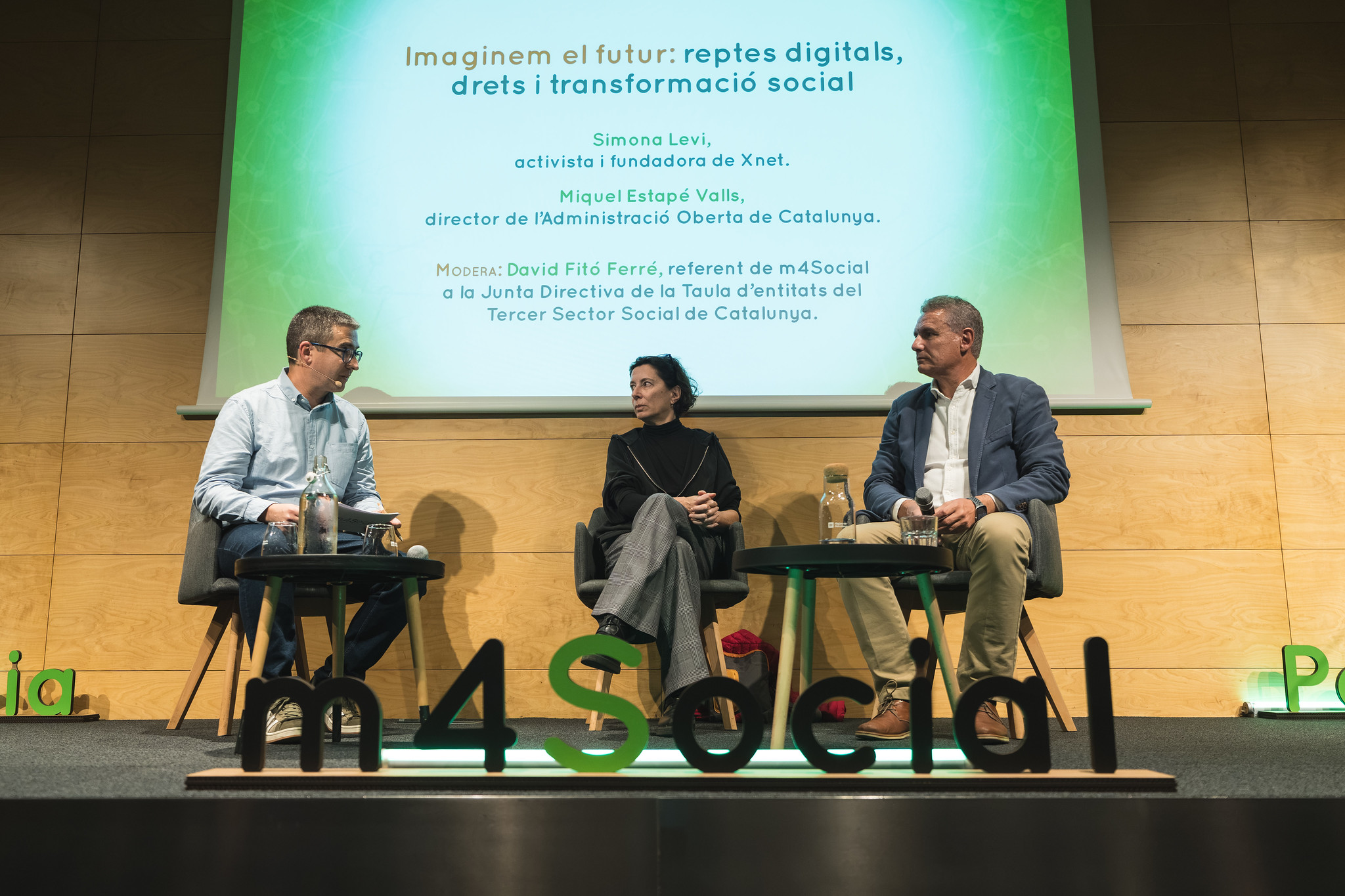
m4Social, the digital innovation project of the Third Social Sector Board of Catalonia, celebrated its first ten years with the conference "10 years of technology at the service of people", on November 12 at the Barcelona Activa Auditorium. The event reviewed a decade of digital transformation of the third sector, presented five technological solutions applied to social challenges and culminated with the presentation of the SocialTec manifesto.
The managing director of the AOC, Miquel Estapé, participated in the future debate with activist Simona Levi, founder of Xnet, with a thesis that runs through his entire intervention: technology only matters because of what it changes in people's lives.
Estapé has maintained that we have digitized a lot and transformed little, and that the great opportunity is proactive services: that the Administration offers aid to those who are entitled to it without having to ask for it. The brake is not technological, it is regulatory and organizational. Structural reforms are needed in the Administration so that it can face the new challenges, and for this reason the impetus of the third sector is essential.
m4Social was born in 2016 to bring digital innovation closer to third sector entities. Ten years later, the celebration day brought together the Administration, the technology sector and entities: it was opened by Sara Díaz, from Barcelona Activa, and Xavier Trabado, president of the Board, and closed by Sandra Ruiz, general director of Digital Economy and Society; Eva Giménez, general secretary of the Department of the Presidency, and Raúl Moreno, minister for Social Rights and Inclusion, via video.
Estapé's intervention began with an uncomfortable observation. The Catalan public sector is one of the most digitized, more than most companies and entities, but twenty years of digitization have not translated into greater efficiency or agility, because structural changes in processes, organization and regulatory framework have not been made. And when digitization does not transform, the digital divide becomes a rights divide: behind every complex form and every notification that does not arrive there is a person who is not exercising a right, and vulnerable groups are the most harmed.
How should citizens notice this? In two indicators: deadlines, that aid is resolved in 30 days and not in a year; and coverage, because in many essential services the Administration reaches half or less of the people who are entitled to it.
The opportunity that cannot be missed is proactive services: the Administration already has the data to know who is entitled to assistance and still does not receive it. The model is the draft income that we have been successfully applying for 20 years: the Administration presents the proposal with the information it has and the person only confirms it. Portugal, Austria or Estonia do this in some social services with the same General Data Protection Regulation.
Why can't we do it here? According to Estapé, because the brake is regulatory: the use of tax data for non-tax purposes has very severe restrictions.eres, and the Social Services Act and the Statute of Autonomy of Catalonia establish that benefits must be requested, so they cannot be granted proactively. And when sensitive personal data is processed to assess the situation of a family, the prior consent of all adult members of the family is required, which makes proactivity almost impossible.
The third sector has an important social role: promoting constructive social pressure, which generates cross-cutting political consensus, to modify the rules that leave out those who need it most.
How can the pace of digitalization and the guarantee of rights be reconciled? Reinvesting the significant savings generated by digital transformation into more human attention for those who need it, because around 20% of citizens have serious difficulties in relating to the Administration.
An example is the AOC support service: from 80.000 to 250.000 annual requests for help, of which the chatbot resolves nearly 200.000; the savings are being reinvested in assisted processing, to provide step-by-step support, for those who cannot get by with automatic channels.
Simona Levi highlighted that, faced with the enormous technological challenges that the Administration must face, it needs to incorporate talent that knows how to evaluate, supervise, direct and execute technologies such as artificial intelligence (AI) with a public vision and an ethical and responsible application.
Estapé agreed with this and defended the Professional Public Management Bill, currently being processed in the Parliament of Catalonia, which has met with reluctance from both left-wing and right-wing groups. For Estapé, it is a strategic talent project: it aims to guarantee that the best professionals are at the head of public services, chosen openly for their merit and ability. According to Estapé, it is a measure that should gain consensus, because it responds to the general interest from any perspective: the progressive, because it guarantees quality public services that reach everyone; the conservative, because it ensures efficient public services, without waste and with better control of fraud.
The commitment that Estapé has proposed for the next ten years is the structural reform of the Administration, with a single criterion: the general interest. The Government of the Generalitat of Catalonia has proposed an ambitious reform of the Administration. Now what is needed is to gradually implement it and consolidate it.
The third sector is the ally to exert pressure when the interesindividuals stop it. The SocialTec manifesto, presented at the end of the day, opens this path. As Estapé summarized, reforms are not done by the brave alone: they are done by the brave accompanied. In ten years, m4Social will celebrate its twentieth anniversary by explaining not what it has denounced, but what it has changed.