

The Forum of e-Procurement Experts presents the latesteres new features and improvements for 2027


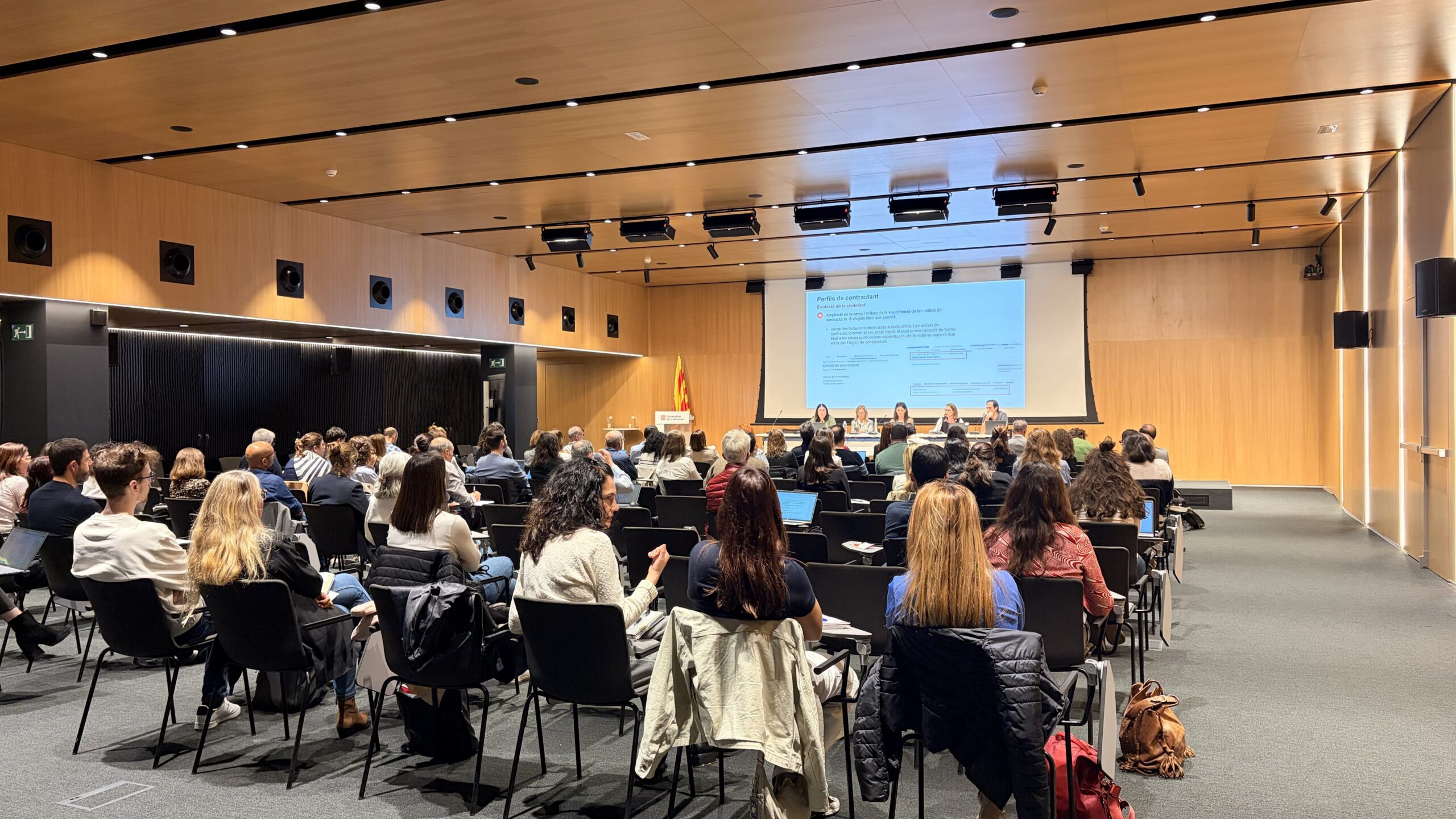
The Technical Secretariat of the Public Procurement Advisory Board On November 17, a new edition of the Forum of experts in e-Procurement was held at the Administrative District of the Generalitat, aimed at professionals from local authorities and universities.
The conference reviewed recent regulatory changes, the latest developments in the Public Procurement Services Platform (PSCP), the improvements planned in the DEUC and the RELI, and the strategic roadmap: incorporation of scorecards for contracting bodies, artificial intelligence initiatives applied to public procurement, the future evolution of corporate tools, with special attention to the renewal of the Public Contracts Registry and the tools eLicitaAll the projects presented have been aimed at improving the user experience, data quality and evidence-based decision-making.
The AOC Consortium has participated as the entity responsible for the deployment of these tools in the local world and universities, with more than 1.400 user entities. The managing director, Miquel Estape, has argued that digitizing procurement is necessary, but not sufficient: the objective is to eliminate work for administrations and companies. The integration between the PSCP and the Public Register of Contracts is proof of this: around 4.000 hours and 93.000 euros per year that the local world will no longer dedicate to entering the same information twice.
The AOC provides services to more than 2.250 public entities with around thirty services and, in most cases, assumes their comprehensive management. Public procurement works differently: the three country services —the PSCP, eLicita and the Public Contracts Registry— are led by the Generalitat through the Consultative Board, and the AOC acts as a bridge with the local world and universities. It manages their deployment, support and integrations, collects local needs to transfer them to the evolution of services and, through an agreement, assumes the costs of use. For a city council, the consequence is simple: it has the same bidding platform as the Generalitat without having to contract, maintain or pay for it.
What does the AOC contribute to this scheme? Above all, the local perspective. Half of the municipalities in Catalonia have less than 1.000 inhabitants, and a contracting tool must serve equally well a large administration and a town hall with a single person as secretary. This requires a practical vision: agile, secure tools, easy to integrate and that avoid unnecessary work. And three levers: automate everything possible, seriously apply the principle that data is requested only once, and take advantage of artificial intelligence for repetitive tasks, with legal guarantees and human supervision.
Until recently, local authorities and universities entered the data for each tender twice: in the Contractor Profile and then in the Public Contracts Registry. Now the two systems are integrated and the information is entered only once, saving more than 58% of the work and management costs, according to the AOC estimate, in addition to fewer errors.
The second line of progress is the integration of the PSCP with case managers. There are already 21 integrated and active entities, with the outstanding work of the Barcelona and Sabadell city councils; the integrations of T-Systems, Guadaltel, Pixelware are in production, Gestiona, Audifilm and Nexus will be added soon. Nearly 3.000 cases already circulate through this channel. Each integration with a provider serves all the entities that are its clients: it is done once and everyone benefits from it.
A third new feature that will add value in terms of automating procedures for file managers of contracting bodies in these areas will be the implementation of a new query in the catalogue of services. Via Oberta which will allow you to obtain both the data of the companies registered in the Register of Bidding and Classified Companies (RELIC), as well as the certificate provided by this service to guarantee that the companies meet the necessary requirements to be awarded contracts.
From the point of view of the AOC, four major priorities are considered:
The first is interoperability: not asking a company or a public employee for information that the Administration can already obtain. It means automating queries that are currently done manually —RELIC, powers of representation, Commercial Registry, tax certificates—and stop requesting documents from companies. It is a legal obligation and, above all, the most real simplification that can be offered.
The second is artificial intelligence, at all stages of the tender: helping companies to check that the offer complies with the specifications before sending it, and supporting the Administration in the preparation of specifications, the review of offers, the extraction of metadata and the anonymization of documents. It does not replace professional judgment: it deals with what is repetitive.
The third is a shared challenge: promoting registration in RELIC. According to e-FACT data, around 100.000 companies invoice the Catalan public sector, but less than 20% are listed in the Electronic Register of Bidding Companies. The company needs to see a clear benefit —fewer documents, fewer procedures— and the administrations need to stop asking for what the register already certifies.
The fourth is to evaluate the impact, not the activity. It is easy to fall into vanity metrics: figures that grow but do not measure public value. Two years ago, more than a hundred very small municipalities did not publish any contracts on the Contractor Profile, not even the smallest ones, despite having the solution at hand. With analysis and support, the figure has been reduced to residual levels. Evaluating is distinguishing what works from what only seems to work.
The challenge is not to incorporate more technology. The challenge is for technology to make life easier for the Administration, businesses and citizens.