

The AOC explains the new financing model planned for January 2027: video of the information session


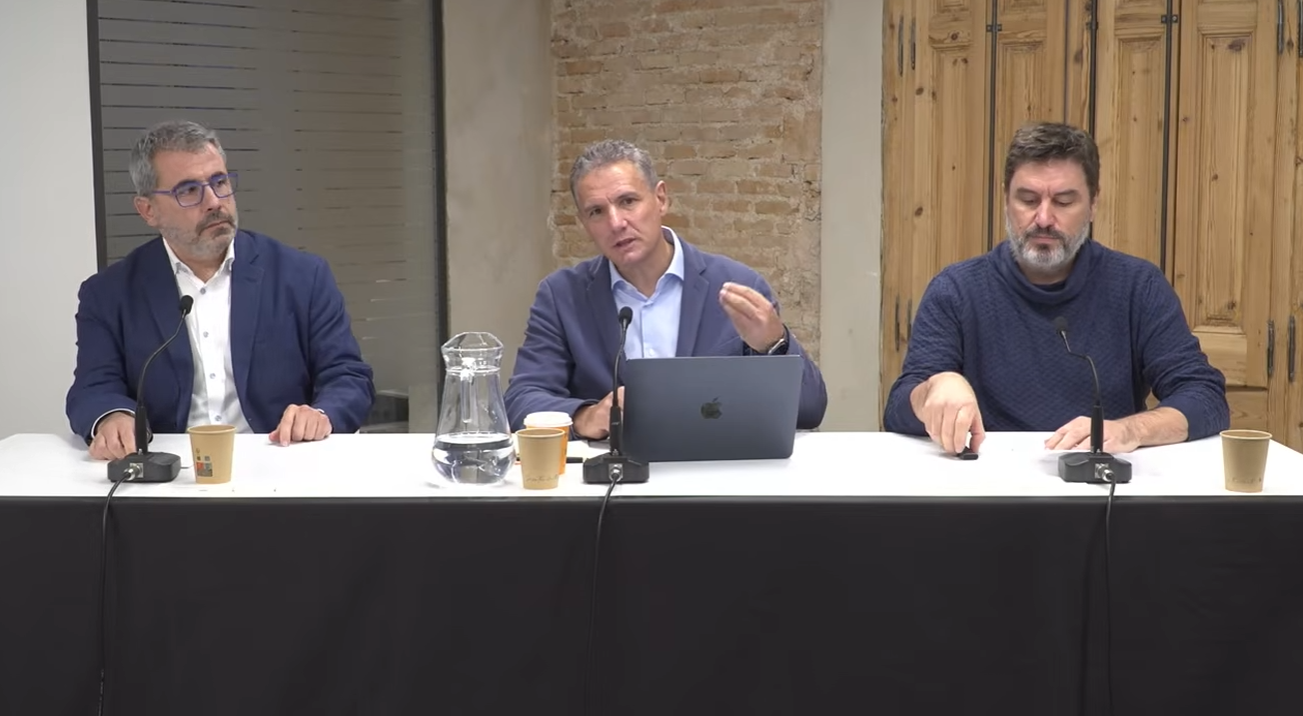
The AOC held an online information session on November 18 to explain the new financing and public pricing model, which is expected to come into force on January 1, 2027 within the framework of the new Statutes of the Consortium.
The managing director of the AOC, Miquel Estape; the general director of the Localret Consortium, Andrew Francisco, and the director of Technology Services and Corporate Systems of the Barcelona Provincial Council, Francisco Javier Gimenez, who spoke in representation of the four provincial councils.
You can retrieve the video of the session from the AOC's Youtube channel:
The AOC is a consortium in which administrations share the benefits of common digital services and also the responsibility for sustaining them. The current model, however, did not adequately reflect this reality. The Generalitat provided 96% of the resources, while the local world and the rest of the entities generated approximately 40% of the activity.
In addition, the use of AOC services has grown very significantly: from 557 million transactions and operations in 2022 to 968 million in 2026. This representa an increase of 74% in five years.
The new model establishes contributions based on three criteria:
The result is a solidarity-based, proportional and asymmetrical distribution. The Generalitat continues to be the main partner and assumes approximately 80% of the total cost, but it is no longer practically the sole financier.
This model is part of the new Statutes project, initially approved by the General Council of the AOC on November 2. The Statutes strengthen the participation of the local community: the four provincial councils are incorporated into the Governing Council, made up of thirteen members, seven of whom are representaof the Generalitat, four of the provincial councils and two of Localret, with a weighted voting system of 60% and 40%.
To complete the process, it will still be necessary to formalize the adhesion of the provincial councils, the ratification of Localret, the Agreement of the Government of the Generalitat and the approval of the public price order.
The AOC's 2025 liquidated budget was 24,6 million euros. The new model distributes this cost into three blocks:
The first two blocks include the structure of the Consortium and essential infrastructures such as digital identity platforms, interoperability or electronic notification. The Generalitat assumes them in their entirety as the government of Catalonia, since they are national infrastructures that it would have to guarantee even if the AOC did not exist.
Only the third block is distributed: the marginal direct cost of use, that is, the additional expense that each administration generates when using the services.
Of the total budget of the AOC, the Generalitat contributes approximately 80%; the provincial councils, 8%, and the entities subject to the public price, 12%.
The provincial councils play an essential role in guaranteeing the territorial solidarity of the model. Each one will assume its own use and that of the town councils with less than 20.000 inhabitants in its territory, as well as that of the entities that depend on them.
This allows a municipality of a thousand inhabitants to continue accessing the same digital services and with the same guarantees as a large administration, without having to make any direct contribution.
Consequently, 93% of Catalan city councils will not receive any invoices from the AOC.
The regional councils will receive a bonus in recognition of the support they provide to small municipalities. Localret, for its part, will cover the cost of its own use.
The public price will apply to non-consortium entities: municipalities with more than 20.000 inhabitants, universities, statutory entities and other public entities. Since each invoice will group the parent entity and its dependent entities, it is expected to issue approximately 750 invoices annually.
The new system will replace the current prices of T-CAT andHèstia and will substantially simplify administrative management. Each parent entity will receive a single annual invoice, which will also include the activity of its dependent organizations.
This change will allow the transition from around 10.000 annual invoices mainly associated with the T-CAT to around 750 consolidated invoices. According to the AOC's estimate, the simplification can save approximately 7.000 annual hours of administrative processing.
The public price does not reflect the real value of the services provided by the AOC. It only covers the additional cost generated by the activity of each entity, once the Generalitat has already assumed the structural costs and common infrastructures.
The calculation combines two components:
Business transactions will be recorded, such as:
In 2027, all these transactions will have the same unit cost. Support operations, such as PSIS validations or SMS notifications, will not be counted.
2027 will be a transition year. The full fixed cost will apply, but the variable cost will only be calculated on the activity recorded between January and October. The single invoice will be issued in November and will be processed as a public price of general application, without the need to formalize any contract or agreement.
With a budget of 24,6 million euros, the AOC provided around thirty digital services in 2025 that processed 869 million transactions and operations. This equates to an average cost of approximately 3 cents per operation.
This level of efficiency is possible thanks to a shared model that avoids each administration having to develop, maintain and operate the same solutions on its own. At the same time, it ensures that digital identity and public data are managed within the public sector.
The value of the model is also measured by the return it generates for the administrations as a whole and for citizens.
According to the AOC savings methodology, reviewed within the framework of an evaluation co-financed by the PROAVA program and with the participation of Ivàlua, the use of AOC services generates estimated annual savings of 744 million euros.
One of the main savings opportunities is e-NOTUM+, an initiative that promotes electronic notification as the first option for people not required to interact electronically with the Administration, maintaining paper as a guarantee.
The system plans to send complementary notices by email and mobile phone using the contact details associated with idCAT Mobile, which currently allows reaching more than four million people. If the notification is made electronically, it is not necessary to send it by post. If it is not made within the established deadline, it is sent on paper.
The local world allocated approximately 38 million euros to postal notifications in 2025. The AOC estimates that a 25% reduction in this expenditure during the first year of e-NOTUM+ deployment could generate annual savings of between 9 and 9,5 million euros.
This estimate is a projection based on a progressive reduction in the volume of postal shipments. The AOC is developing pilots with BASE, the revenue management body of the Tarragona Provincial Council, and the Tax Management Body of the Barcelona Provincial Council to validate the operation of the model and measure its results.
With a gradual deployment, the technological evolution of the service and the necessary regulatory impetus, the percentage of notifications carried out electronically could increase in the following years. The extension of theidCAT Mobile and the high availability of mobile phones among the population reinforce the potential of the initiative, but the effective savings will depend on the actual percentage of notifications that citizens consult electronically.
In any case, the potential savings for administrations may be much higher than the planned contribution to the financing of the AOC.