

The open data portal continues to evolve: XLoader, DCAT and a new data query experience



The Open Government service's open data portals continue to evolve to offer an increasingly robust, interoperable experience oriented towards the reuse of public information.
In recent months we have incorporated several improvements to the CKAN platform used by open data portals. Some of these actions were already presented on the occasion of World Open Data Day, and now they become part of the effective evolution of the service.
Among the main innovations are the incorporation of DCAT standards, new data query experience based on DataTables and the migration of DataPusher to XLoader.
This set of improvements strengthens both the technological infrastructure of the portals and their interoperability and query capabilities.
One of the most relevant actions has been the replacement of DataPusher with XLoader, the CKAN component responsible for automatically loading tabular data from resources published in the DataStore.
This functionality already existed with DataPusher, but XLoader provides a more modern architecture aligned with current versions of CKAN, which allows us to have a more efficient, sustainable infrastructure prepared for the future evolution of the service.
Migration brings several advantages:
In practice, this improvement makes it easier for us to work with larger data sets i publish more extensive historical series with more efficient and reliable behavior, improving the portals' long-term growth capacity, which also results in improvements to the portals transparència.
The portals also incorporate support for DCAT and DCAT-AP-ES standards, an evolution that facilitates the exchange and reuse of metadata between different administrations and open data catalogs.
To obtain the catalog, you must access the desired dataset and locate the “Metadata Access (DCAT-AP-ES format)” section that each resource offers in its metadata catalog descriptor. This contains a drop-down menu that allows you to choose between 4 different formats: XML, RDF, Turtle and JSON-LD.
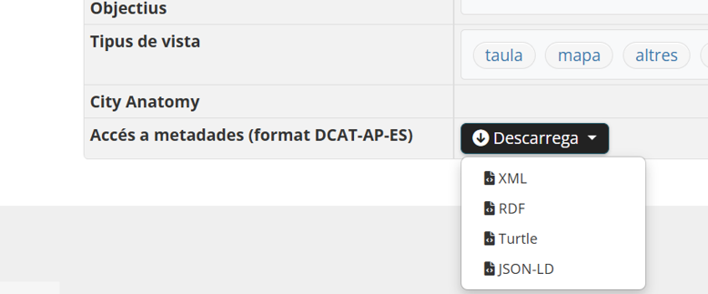
Image 1: Screen of a resource on the open data portal, where access to metadata in DCAT-AP-ES format can be downloaded
This capability improves the interoperability of portals and promotes greater visibility and reuse of published datasets, facilitating their integration with other open data initiatives.
Another of the improvements incorporated is the renewal of data visualization using DataTables technology.
The new query interface allows:
This evolution facilitates both the timely consultation of information and its reuse by citizens, companies, the media and public administrations.
The incorporation of XLoader, the adoption of DCAT standards and the new query experience with DataTables represent a new step in the modernization of the Open Government service's open data portals.
With these improvements we reinforce our commitment to offering local entities an increasingly robust, interoperable platform prepared to promote transparència, data openness and the effective reuse of public information.