

The Digital Maturity Index: behind a digital city council there is a way to measure it


A few years ago, in many city halls, completing a procedure still meant traveling, standing in line and carrying papers from one counter to another.
Today, however, it is increasingly common to carry out procedures from home, at any time, without having to provide documents that the administration already has. But… how do we know to what extent this transformation is real? How can we know which local entities are advancing the fastest? And, above all, how can it be improved?
This is where a key tool comes into play: theDigital Maturity Index (IMD) of the AOC.
A tool that was born to ask questions
The IMD was not born as a ranking, but as a necessity.
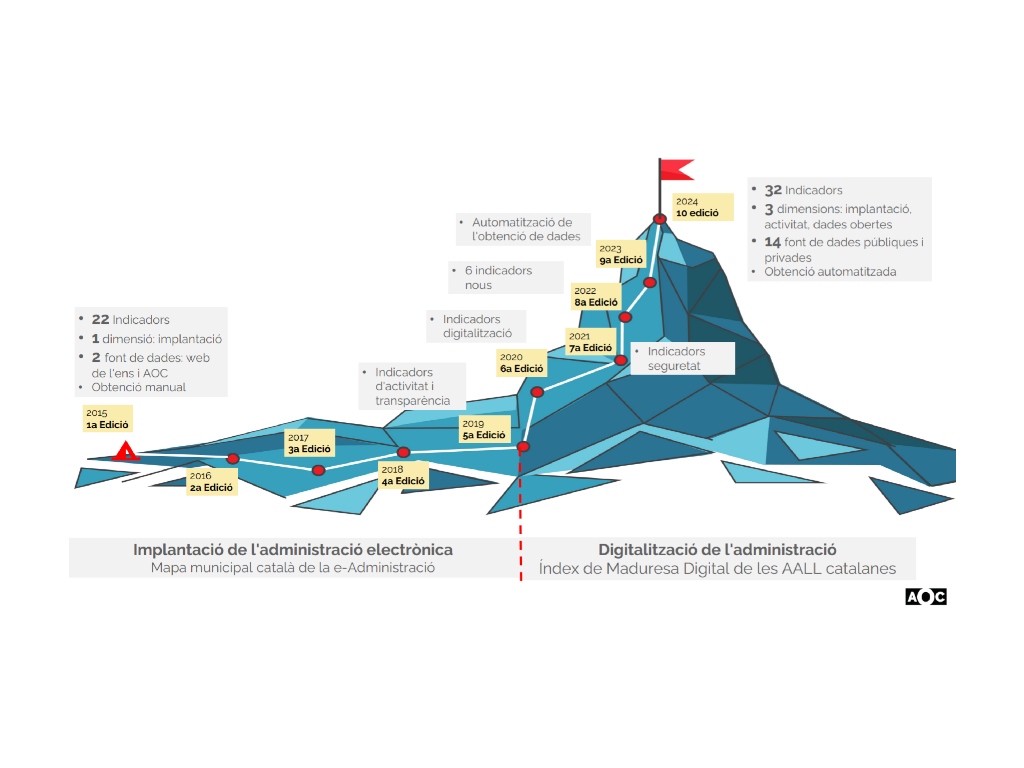
More than a decade ago, at the AOC we asked ourselves a simple but fundamental question: How can we know if the digital transformation of local authorities is working?
And, even more importantly: How can we help them move forward?
From here, a model based on real data—not perceptions—was built, capable of examining the digitalization of the city councils and county councils of Catalonia.
From “we have digital services” to “they are actually used”
Over time we have learned that digital transformation is not just about having technology.
There are town halls that offer online procedures, but with little use. Others have made a significant leap because they have managed to get citizens to incorporate them into their day-to-day lives.
Therefore, the IMD looks further:
In other words, it doesn't just ask "what do you have?", but also "how do you use it?" and "what impact does it have?".
When data tells stories of transformation
Behind every IMD score are real stories.
Small town councils that, with few resources, have managed to digitalize most of their procedures.
County councils that have opted for interoperability to simplify the lives of citizens.
Teams that have driven internal changes to leave paper behind.
IMD not only allows us to see who is best positioned, but also to detect patterns: what works, what can be replicated and how entities evolve over time.
A compass to guide the way
For local authorities, the IMD has become much more than a still photo: it is a management tool.
It allows, for example:
In a context where resources are limited, having a compass like the IMD is key to making informed decisions.
The starting point of the AOC Recognitions
Every year, this analysis also translates into a moment of recognition.
El May 20 have been delivered Acknowledgments Open Administration, who arrive at their eleventh edition, and that highlight local entities that lead their category in digital transformation.
But these recognitions are not the result of a vote or a subjective perception. They are based on IMD data.
They are, in this sense, the visible face of a silent work that happens throughout the year.
Beyond the awards
However, the ultimate goal is not the prizes.
What really matters is the path: moving towards an administration:
With the publication of the new IMD results, we once again have an updated picture of this collective progress. A picture that, more than showing who is at the helm, helps us understand how the digital transformation of the local world is progressing —step by step—.