

Local world master data: what it is and what it is used for


In many town halls, especially the smallest ones, day-to-day operations are based on the knowledge and experience of the people who work there. Someone knows what the good file is. Someone knows how a street name has always been written. Someone remembers that an entity changed its name. Someone knows that that facility is on a list, but it is no longer used as before.
This way of working can solve many everyday situations, but it also creates an important problem: the same information can end up appearing in different ways depending on the service, application or document.
A person may have different data in the registry, taxes or social services. An address may be written in three different languages.eres. A facility may have different names in a report, in an activity agenda and in a patrimonial list. A supplier may appear duplicated. An entity may appear with an old name.
These are not just minor administrative messes. They are problems that affect data quality, internal coordination, and the provision of public services.
Therefore, after talking about inventory, metadata and data quality, it is important to introduce another key concept: master data.
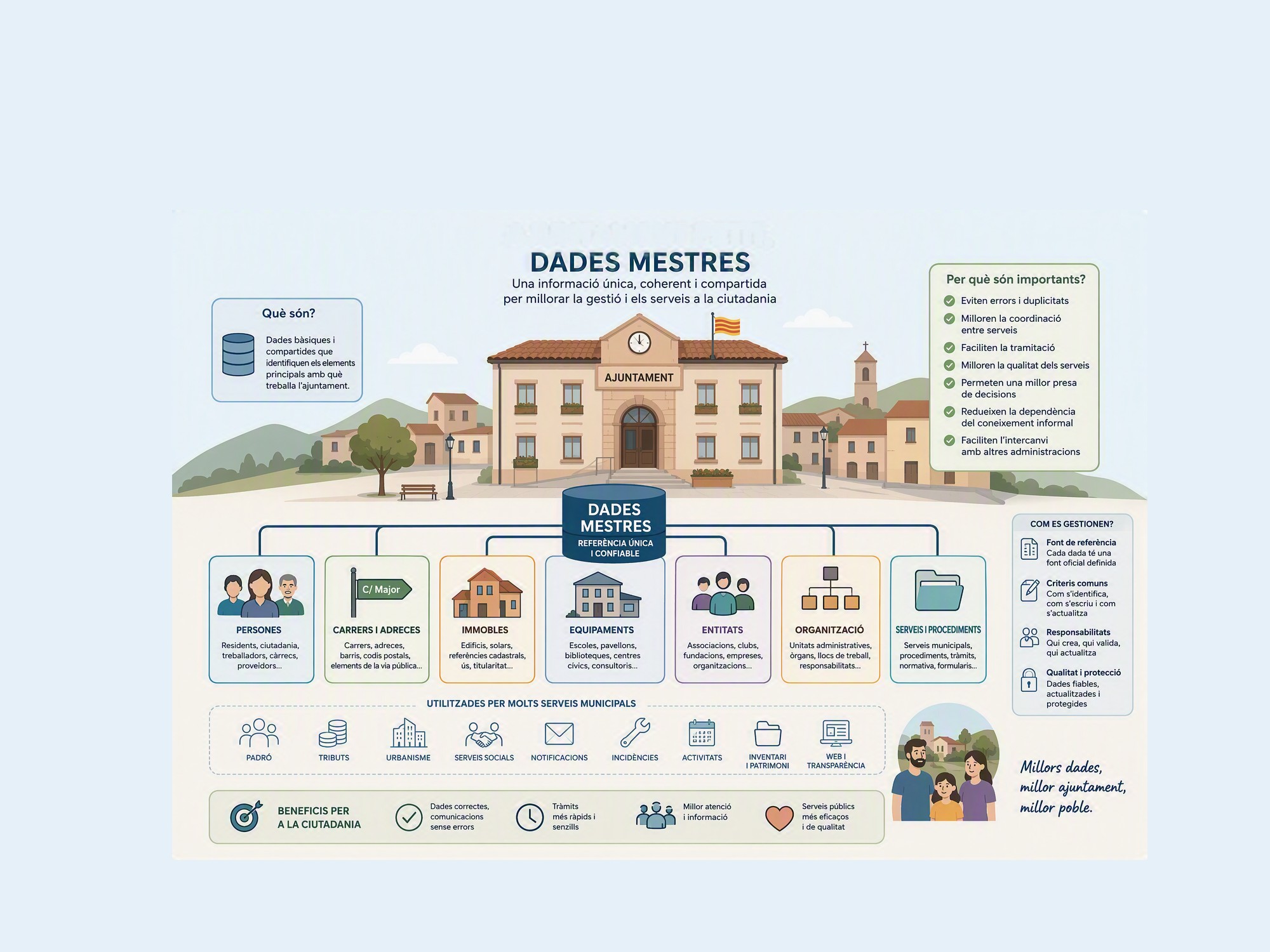
Master data is the basic, shared data that identifies the main elements that an organization works with. Put simply, it is the data that many areas of the city council use and that should mean the same thing to everyone.
In a town hall, among others, master data can be:
This data is important because it appears in many municipal procedures, systems and processes. For example, the data “address” can appear in the population register, taxes, urban planning, notifications, social services, public road incidents, activities, facilities and transparènciaIf this data is not consistent, everything that depends on it can be affected.
In a city council, talking about master data may seem too technical. But in reality it is a very practical necessity. Master data helps to avoid errors and duplication. It also makes it easier for municipal services to work with a common vision. When master data is well organized, the city council can better know who is talking about, what place is talking about, what equipment is talking about or what file is talking about.
This is especially useful in small municipalities, where many people work with multiple responsibilities at the same time and where there are not always specialized teams to review data, integrate systems, or maintain complex catalogs.
Having minimal, well-maintained master data can help:
It's not about doing a big technological project. It's about identifying what basic data is shared, unifying it in a single tool where it resides, and taking care of it.
Personal data is one of the most important master data in any city council. It appears in the population register, in files, in social services, in taxes, in notifications, in applications, in check-ins, in activities or in communications with citizens. When this data is not well managed, problems such as duplicate people, names written differently, outdated contact details or incomplete identifiers can appear.
This can cause errors in notifications, difficulties in relating procedures, confusion in citizen care or problems in the management of aid and services. However, personal data is also particularly sensitive. Therefore, it is not only necessary that it is correct. It must be protected adequately, access must be limited, used only for legitimate purposes and traceability must be guaranteed. In this case, quality and data protection go hand in hand.
The territory is another large area of municipal master data. Streets, addresses, properties, neighborhoods, areas, facilities and elements of the public road are essential information for the functioning of a city council. A misspelled or non-standardized address can affect the registry, notifications, licenses, taxes, incidents, censuses, urban planning or local services. That is why it is important to have common criteria to identify and describe addresses, streets and properties.
This work may seem minor, but it has a lot of impact. If the city council works with a coherent vision of the territory, it can plan better, detect needs, manage incidents and provide services with more precision. The territory is one of the keys to connecting municipal data that is often dispersed in different systems.
Municipal facilities should also be a master data. A nursery school, a pavilion, a library, a civic center, a doctor's office, a sports field, a community center, a municipal warehouse or an administrative building can appear in many places: heritage inventory, activity agenda, maintenance, budget, energy consumption, transparència, municipal website or investment plans. If each area uses a different name or maintains its own list, it will be difficult to have a global vision.
A master data of facilities should allow us to know, at a minimum, which facilities exist, where they are, what service they provide, who manages them, what use they have, what condition they present and what other data they are related to. This information can help plan maintenance, prioritize investments, optimize spaces, better inform citizens and build management indicators.
Master data does not only refer to citizens and territory. It also includes administrative units, government bodies, jobs, municipal services and procedures. This helps to know who is responsible for what, who processes, who validates and who must update certain data. Organizing this data helps to improve internal management.
When talking about master data, you might think that you need to create a single, large, centralized database. But not necessarily. In a small municipality, the first goal should not be to build a large technology solution. The first goal should be to agree on what basic data is common and how it should be identified. The data may still be in different applications, but you will need to know what the reference source is for each piece of data.
For example:
This reduces contradictions. When there are doubts, the city council knows which data should prevail. This criterion is very important to prevent each service from maintaining its own “truth”.
Master data does not appear in isolation. It is part of the same path that we have been explaining in previous posts.
Therefore, a small municipality can start by detecting, within its inventory, which data appears in the most services and systems. These data are likely candidates to be treated as master data. If a piece of data is used by many areas, affects essential services or is necessary for decision-making, it needs to be taken special care of.
A small town council can start very simply.
You don't have to start with all the master data. You can start with one or two that generate a lot of problems or have a lot of impact.
A good case to start with could be the data on municipal facilities. It is a relatively limited data, useful for many areas and with a direct impact on citizens. The city council can make an initial common list of facilities, assign an official name, indicate the address, type of facility, responsible service, status, main use and public information that can be displayed on the website.
From here, this data can be used for activities, maintenance, budget, consumption, transparència, planning and citizen information. With an acceptable effort, the city council goes from having several partial lists to having a common reference. This is working with master data.
Small municipalities should not be left to decide on their own which master data is important or which model to follow. XGLI can provide value through its working groups, helping to establish a common data governance model for the local world. This model will identify which master data is a priority for local authorities, can identify what minimum metadata needs to be described and what responsibilities need to be defined.
The groups are working to build a shared vision on local master data: people, territory, facilities, entities, suppliers, organization, services and procedures, etc. This will allow city councils not to have to start from scratch and to have common models adaptable to their size and capacity.
Another important area will be the description of professional profiles and functions. In a small town hall there may not be a person dedicated exclusively to master data, but it will be necessary to identify who validates, who updates, who corrects, who documents and who decides which is the reference source.
Finally, the Network can implement shared use cases that show the value of master data: improving the quality of addresses, ordering municipal facilities, providing common indicators or preparing proactive services based on reliable information.
The value of XGLI will be to convert a complex need into a shared, practical and achievable model.
The Local World Data Space aims to help local entities make better use of their data through common criteria, models, services and infrastructures.
In this context, master data is a fundamental piece. Without coherent master data, it is difficult to integrate systems, build reliable indicators, share information between administrations or deploy more proactive digital services.
The AOC Consortium, in collaboration with provincial councils, county councils and other local actors, can contribute to promoting this shared model so that small councils do not have to solve a challenge that is common to the entire local world alone.
The key is to move towards common criteria that help organize the most important data, protect it better and reuse it with guarantees.
Master data is the basic data that makes it possible for a city council to speak the same language within its own organization. They are pieces that appear again and again in municipal management. If this data is inconsistent, duplicated or unreliable, the city council works with more effort and more risk of error. If this data is well identified, described and cared for, the city council can process better, inform better, plan better and decide better.
There is no need to build a large data platform. We need to identify what basic data we share, know what the reference source is and agree on some minimum criteria. This is a modest step, but very important. Because when a city council organizes its master data, it begins to build a solid foundation for more efficient, reliable and citizen-oriented public services.