

The AOC participates in the Conference on rights of access to information to share the vision of data protection in documentary preservation


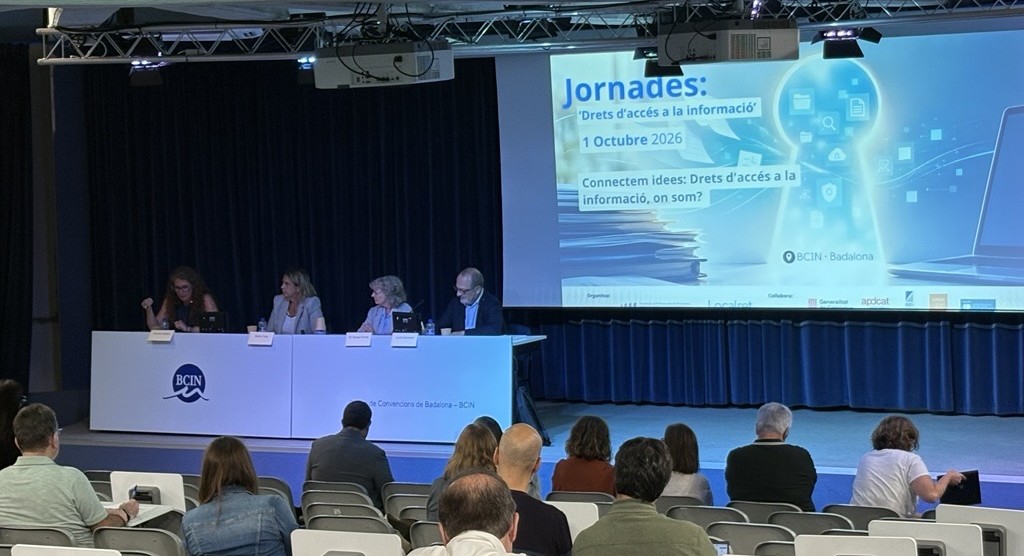
The AOC data protection officer participated in the roundtable on October 1 "Documentary evaluation and access rights", held within the framework of the conference "Rights of access to information", organized by the Association of Professionals in Archiving and Document Management of Catalonia and the Localret Consortium at the BCIN in Badalona.
The session, under the motto "Let's connect ideas: Rights of access to information, where are we?, brought together professionals and representaof institutions linked to document management, the transparència and data protection to reflect on the current challenges of rights of access to information and their relationship with document preservation policies.
The roundtable focused on the role of the National Commission for Access, Evaluation and Selection of Documents (CNAATD) within the Catalan system of access to information, together with other key actors such as the APDCAT and the GAIP. Specifically, the impact of decisions on document preservation and disposal on the exercise of access rights was addressed.
During her speech, the AOC's data protection delegate highlighted the importance of the Documentary Access and Assessment Tables (TAAD) as an essential instrument for implementing data protection regulations with guarantees. However, she pointed out that, in practice, these tools still do not have the prominence they should have in many organizations.
One of the central messages of the intervention was that document management regulations and data protection regulations share the same purpose: to retain information only for the necessary time, avoiding unjustified accumulations, but at the same time guaranteeing the different access rights provided for by the legal system.
In this sense, it was highlighted that the main challenge is not so much legal as organizational. Often, document management, data protection and the design of administrative processes evolve separately, which makes it difficult to have a comprehensive vision of the information life cycle.
La representaThe AOC's director stressed that TAADs are an essential tool to comply with some of the fundamental principles of the General Data Protection Regulation (GDPR), such as limitation of the retention period, data minimization or privacy by design and by default.
In addition, he stressed that these tools allow for the definition of coherent retention periods, the establishment of appropriate data blocking and deletion policies and the provision of real content to the Processing Activity Records, thus contributing to a more efficient and secure management of public information.
Another aspect highlighted was the need to incorporate TAAD from the design phase of administrative processes and information systems. In this way, retention periods, as well as mechanisms for transferring, blocking or eliminating information, can be integrated from the start and not as a sudden decision once the system is already in operation.
This approach facilitates regulatory compliance, improves organizational efficiency, and reduces risks associated with excessive data retention.
The intervention also highlighted the relevance of TAADs in the field of common digital administration services that the AOC provides to all Catalan administrations.
Having uniform criteria for document conservation is especially important in this context, as it allows for standardization of deadlines, offers greater legal certainty and guarantees consistent application of legal obligations for both public administrations and citizens.
In conclusion, the AOC data protection officer claimed that TAADs are a tool that goes far beyond document management. As she highlighted, they contribute to strengthening the transparència, protect the right of access to information, provide legal certainty and promote responsible management of public documentation.
The intervention ended with a reflection on the democratic significance of documentary conservation decisions: determining what is preserved, for how long and what is eliminated is not just a technical or administrative issue, but a decision that conditions the ability of citizens to know, understand and monitor public action both in the present and in the future.