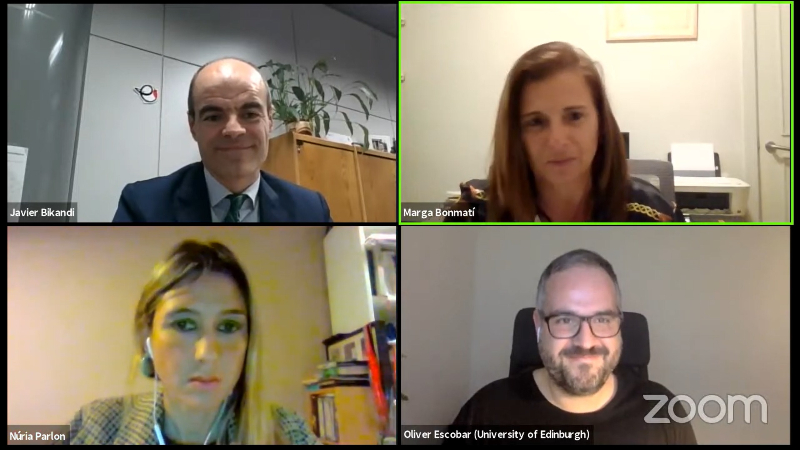
The day "Tools for good governance of local bodies: an international view” held on January 11 presented good practices in governance from the Basque Country, Scotland and Catalonia. It was the first session of a three-day cycle dedicated to good governance of local authorities organized by DIPLOCAT and the Secretariat of Transparència and Open Government of the Department of Foreign Action, Institutional Relations and Transparència.
The cycle is mainly aimed at elected officials and local administration technicians, and offers a theoretical and practical view of the instruments of good governance and open government available in Catalonia. Reference is also made to the resources that international organizations such as the Council of Europe and the OECD make available to municipalities for innovation and the transformation of the public sector.
In welcoming the first session, "Tools for good governance of local bodies: an international vision", the general secretary of DIPLOCAT, Laura Foreigner, explained that “the local world is one of the fundamental pillars of the entity” and that this cycle is part of the Specific Plan for the internationalization of the local world. According to Foraster, “good governance is one of the issues that arouses the most interest at the municipal level, which wants to get closer to the citizens through transparència, accountability and participation”. He also welcomed the attendees Pink Dress, Director General of Local Administration of the Generalitat, and Bernat Sole, Minister of Foreign Action, Institutional Relations and Transparència, who defined open government as an “essential and national tool” and recognized that, precisely in the current pandemic era, offering reliable and open data and the maximum transparència "It is more necessary than ever."
Roger Buck, coordinator in Catalonia of the Open Government Partnership (OGP) project from the Secretariat of Transparència and Open Government, spoke of this “network that includes more than 2.000 entities, based on specific commitments, which are made and renewed within the framework of the summiteres world". Among the actions being carried out, Buch highlighted the recent "Open response & open recovery" campaign to share how COVID-19 is being fought in each country. Catalonia, which has been part of the OGP since October 2020, has committed to working on five topics:
- public integrity and anti-corruption, emphasizing citizen control
- gender perspective and women's rights
- territorial governance and collaboration between administrations
- creation of an ecosystem of participation, which includes activists and social movements
- promotion of a governance system based on open data.
At the round table moderated by the mayoress of Santa Coloma de Gramenet i representaof the Transparent Governments Network, Núria Parlon the director of the AOC Consortium participated, Marga Bonmatí, the Director of Attention to Citizens and Innovation and Improvement of the Administration of the Government of the Basque Country, Javier Bikandi and University of Edinburgh professor and co-director of What Works Scotland, Oliver Escobar.
The portal of transparència of the AOC, collaborative tool
Marga Bonmatí highlighted the Law of Transparència Catalan of 2014, which he described as “very ambitious, which requires publishing a lot of information, often with few resources, and requires a paradigm shift for everyone”. For this reason, the AOC offers the Portal of transparència, a unique collaborative digital tool, currently used by more than 900 Catalan town halls. Among the challenges for the future, he mentioned the continuous approach to citizens, with understandable language and displaying information according to the interests of theeressos; the automation of updates, to make the work easier; and the link with open databases already available.
Euskadi's five commitments
He intervened from Euskadi Javier Bikandi, who spoke about his country's experience in the Open Governments Network, of which he has been part since 2018. The five commitments assumed by the Basques, always on a collaborative basis and together with local bodies, are:
- accountability
- open and interconnected data
- promotion of citizen participation
- impetus for a project of open schools for citizens
- a common framework of institutional integrity and ethics.
The evolution of the various commitments is followed through an open forum. They plan to present a new action plan in April.
Civil society as a key actor in governance
Finally Oliver Escobar he explained that in Scotland there is an organized civil society "that has contributed to prioritizing the agenda of democratic renewal and reform of public administration", often also linked to a defense of more political sovereignty. The administration has responded with various initiatives and laws and since 2016 it has also been part of the Transparent Governments Network. Escobar is involved in the 2014 What Works Scotland programme, which has been key in promoting participatory budgeting in more than 350 localities. With regard to future challenges, he underlined the reluctance that still exists at many levels, formal and informal, also bureaucratic, in front of collaborative, participative and horizontal projects.
After the round table, Núria Parlon made the following conclusions:
- the processes discussed today take time, they cannot be done overnight.
- these processes are necessary to strengthen democracy representative and allow citizens to go beyond casting a vote in a ballot box every four years.
- to be able to carry them out, a change in political and, above all, organizational culture is needed, which is why innovative technological tools are needed, which allow citizens to quickly and easily access information and data.